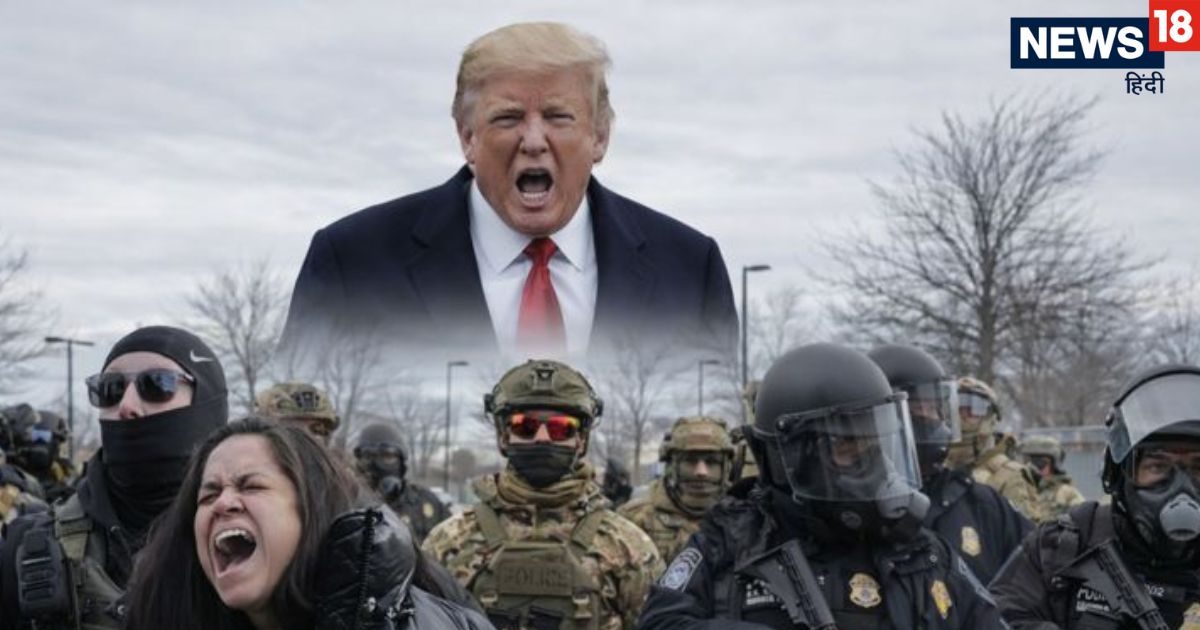
US President Trump threatens Insurrection Act: US President Donald Trump has once again started a political and constitutional debate by threatening to use the army inside the country by talking about implementing the Insurrection Act. This time the target is the state of Minnesota, where large-scale protests are taking place in the capital Minneapolis over the presence of American Immigration and Customs Enforcement (ICE) agents. This development has come to light at a time when an American woman was killed in the firing of an ICE agent a week ago. After this, the Trump administration deployed hundreds of federal agents in the city, due to which the situation became more tense. Now the question is how did the situation worsen? Why is Trump preparing to point guns at his own citizens? Why was there talk of army deployment in a US city and what is this Insurrection Act?
protest confrontation in minneapolis
Violent clashes were again seen between protesters and police in Minneapolis. According to media reports, the situation escalated when a federal officer tried to stop a Venezuelan national during a ‘targeted traffic stop’. Officials claim that while trying to escape, the suspect crashed his vehicle into a parked car. After this, when the officer chased him, the suspect resisted arrest and attacked the officer.
Meanwhile, two other people came out from a nearby apartment and attacked the officer with a snow shovel and a broom stick. When the situation worsened, the officer opened fire in self-defense, injuring the Venezuelan citizen in the leg. The three accused hid in an apartment, but were later taken into custody. After the incident, protesters started gathering in the area. Police used tear gas and flashbang grenades to control the crowd. Commander Gregory Bowin of US Customs and Border Protection is also present on the spot.
Protests against ICE action boil over
These protests are taking place at a time when the Trump administration has intensified its strict campaign against illegal immigrants. Hundreds of federal agents have been deployed in Minneapolis. The city’s Democratic Mayor Jacob Frey appealed to people to maintain peace. Mayor Frey said, “I applaud those who are protesting peacefully. But those who are inciting violence are helping neither this city nor the illegal immigrants living here.” He further said, “Here two government institutions are fighting each other. This situation is not sustainable.”
Why did Trump threaten to deploy the army?
President Trump has warned that if the protesters do not step back, he can invoke the Insurrection Act. Trump wrote on his social media platform Truth Social, “If Minnesota’s corrupt leaders do not follow the law and stop professional rioters and insurrectionists from attacking patriotic ICE officers, I will invoke the Insurrection Act.” However, this is not the first time that Trump has mentioned this law. Earlier, he had also threatened to send troops during the anti-ICE protest in Portland.
What is the Insurrection Act?
Under the US Constitution, under normal circumstances, federal military forces cannot be deployed to maintain law and order within the country. According to the Posse Comitatus Act of 1878, the military cannot interfere in civil law and order unless Congress allows it or the Constitution explicitly allows it. However, the Insurrection Act gives the President the right to deploy troops on American soil in case of emergency. The law states that if there is such rebellion, violence or disorder in any state that it becomes impossible to enforce federal law, then the President can use the army.
Major sections of the Insurrection Act
Section 252 is used in a situation when it is not possible to enforce federal law due to illegal activities or rebellion in a state, then the President can use the army. At the same time, Section 253 can be used when the constitutional rights of people are being snatched away due to domestic violence, rebellion or conspiracy in a state and the state government is unable or unwilling to protect them, then the President can intervene. Under this law, the President has the right to take action even without the permission of the Governor.
How and why was this law made in America?
America’s first President George Washington signed the first version of the Insurrection Act in the year 1792. Under this law, they got the right to deploy the state militia, which later became a unit of the National Guard. This authority was for those circumstances when “the laws of the United States are opposed or the execution of them is obstructed.”
George Washington and his successor John Adams used this law to suppress civil rebellions. These included rebellions against taxes, such as liquor taxes and property taxes. These were considered essential for the survival and financial stability of the newly formed American Republic.
Later, in 1807, the US Congress expanded this law and the amended law reiterated the President’s right to intervene to deal with “insurrection or obstruction of the laws.” In the years that followed, there were many American Presidents who used the Insurrection Act in different ways and at times of need. These include Abraham Lincoln, Rutherford, Woodrow Wilson, Franklin Roosevelt, John Kennedy, Lyndon Johnson and now Donald Trump.
What is criticism and controversy?
The Trump administration is being accused of deliberately increasing tension by sending a large number of federal agents to Minneapolis, so that it can create an excuse for military deployment. Critics say that this step is against democratic values and Trump is being described as a ‘leader moving towards dictatorship’. It is noteworthy that even after losing the election to Joe Biden in 2020, some of Trump’s allies had advised him to remain in power by using the Insurrection Act.
The situation in Minnesota is not just a matter of law and order, but has become a serious constitutional question related to America’s federal structure, civil rights and presidential powers. If Trump implements the Insurrection Act, it will be a major and controversial example of internal use of the military in America’s modern history.