Last Updated:
Harpoon Anti-Ship Missile: China is leaving no stone unturned in equipping the Army, Air Force and Navy with modern weapon systems. Beijing’s goal is to become the most powerful country in the world. This is the reason why after America, China is the only country which has the highest defense budget. Fighter jets equipped with cutting edge technology are the main basis of aircraft carriers and missile defense power. Despite all this, China is facing many challenges at the regional level.
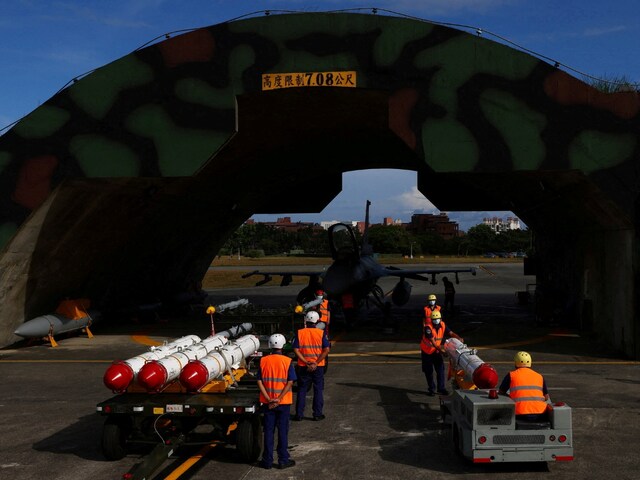

Harpoon Anti-Ship Missile: America has delivered a consignment of Harpoon anti-ship missile system to China’s arch enemy Republic of China i.e. Taiwan. (File photo/Reuters)
Harpoon Anti-Ship Missile: China wants to become the uncrowned king of the world. To fulfill this ambition, it first wants to leave the regional powers toothless and completely weak. There are many countries in East Asia including Taiwan, Vietnam, Japan, South Korea, which are falling prey to the dragon craze. In view of China’s increasing interference, countries like Taiwan, Vietnam and Japan have started equipping themselves with modern weapon systems. Japan is continuously progressing in this direction. According to a recent report, Japan has developed a laser weapon system that can even cut metal. It has been specially designed to shoot down drones. On the other hand, Taiwan is also busy strengthening itself with the help of indigenous technology as well as imported weapons. In this sequence, a big news has come out, due to which the tension in China is sure to increase. It is being told that America has provided a new batch of Harpoon anti-ship missile systems to Taiwan. This report has come to light at a time when the Chinese Navy has increased its activities in the coastal areas of Taiwan.
Taking a major step towards strengthening Taiwan’s defense capabilities, the US has started the delivery of Harpoon anti-ship missile system to the Republic of China Armed Forces (RoCAF). Recently surfaced photographs show mobile missile launchers, radar vehicles and command-and-control units, which are part of this new coastal defense system. Taiwan’s Defense Ministry has ordered a total of 100 land-based Harpoon coastal defense systems and 400 associated missiles from the US, which are considered to bring a revolutionary change in Taiwan’s maritime security strategy. Since 1949, RoCAF’s main forces have been concentrated on the island of Taiwan, where coastal defense systems have a vital role due to geographical conditions. The delivery of these systems is being done in a phased manner according to the schedule agreed between American and Taiwanese officials. Under the plan, 32 systems will be handed over by the end of 2026, while the remaining 68 systems are expected to be delivered by 2027. Defense experts believe that this deal will make Taiwan’s maritime surveillance and counter-measures capability more flexible and dynamic.
- The Harpoon missile, developed by Boeing, is a modern, all-weather, subsonic anti-ship cruise missile. It can travel a distance at a speed of 124 to 280 kilometers per hour and flies very close to the sea surface.
- This missile can be fired from ships, submarines, aircraft and land-based platforms. It has active radar guidance and GPS based navigation system.
- Different variants of Harpoon are available like RGM-84, UGM-84 and AGM-84. The Block-II version can also target coastal targets and ships parked in port.
- A blast-penetration warhead weighing about 500 pounds has been installed in it. The ability to fly at low altitude helps it avoid enemy radar.
- This missile, which came into service in 1977, is still being used in more than 30 countries. With new upgrades it is being made in accordance with modern maritime warfare requirements.
Harpoon Anti-Ship Missile: Harpoon missile is capable of destroying a warship up to a distance of approximately 280 kilometers. (File photo/Reuters)
dragon will be red
The missiles procured for the RoCAF are the RGM-84L-4 Block II (U) variant, which has better range, advanced guidance and targeting capabilities compared to earlier models. However, despite this, questions are being raised about the effectiveness of Harpoon missiles in modern war scenarios. Experts say that due to the relatively slow speed and limited range of these missiles, they can be stopped by sophisticated air defense systems or fighter planes. Apart from this, due to their high cost, it is also considered difficult to use them on a large scale in ‘swarm attack’ strategy. Yet for Taiwan’s Navy, this network of mobile launch vehicles and radar systems remains a key pillar of its asymmetric ‘anti-access/area denial’ strategy against China. These missiles, which can be fired from coastal areas, are considered helpful in limiting the movement of potential enemy naval ships and maintaining the balance of power in the Taiwan Strait. Analysts believe that such mobile systems can be deployed rapidly while avoiding enemy intelligence surveillance, thereby increasing their survivability and effectiveness.
Why is this delivery important?
The delivery of the Harpoon system is part of the US policy to comprehensively strengthen Taiwan’s military capability. In this sequence, supply of Advanced Tactical Missile System (ATACMS), High Mobility Artillery Rocket System (HIMARS) and jointly developed single use unmanned attack aircraft is also proposed. The purpose of these systems is to increase Taiwan’s ability to threaten important military bases on the Chinese mainland. In December 2025, the US Defense Department approved an arms deal worth $11.1 billion, which included the transfer of 420 ATACMS missiles. The first 11 launchers of the HIMARS artillery system had already arrived in Taiwan in November 2024, and the first Taiwanese military unit equipped with them was formed in early July 2025. According to defense analysts, these new systems will significantly increase Taiwan’s ability to conduct long-range precision strikes.
About the Author

Received primary and higher education from Bihar, Uttar Pradesh and Delhi. After graduation from Jhansi, he did PG Diploma in Journalism from Delhi University. Started professional career from Hindustan Times Group…read more