Last Updated:
PM Modi Breathing Exercise: In the second session of discussion on examination, Prime Minister Narendra Modi has asked the students to breathe deeply whenever they get a chance during the day. This is most important after eating. Actually, there are many benefits of taking long deep breaths. This was also proved in science. Also, this is mainly present in our age-old Yoga Vidya.
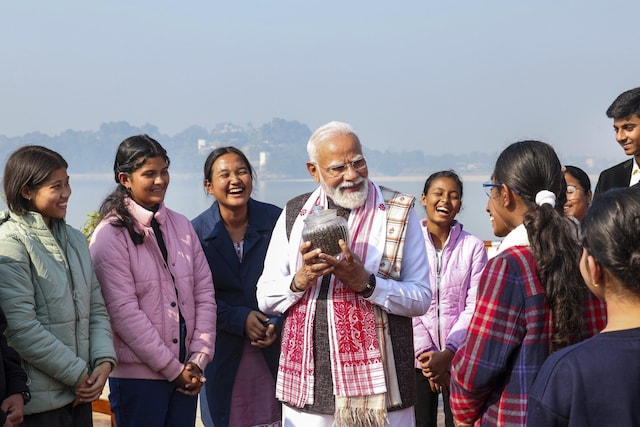

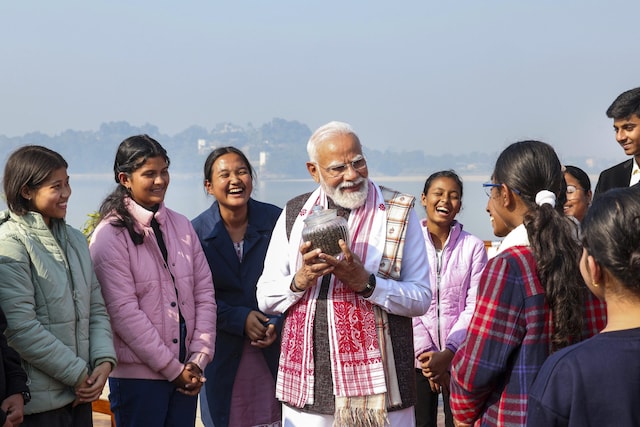
PM Modi with students during discussion on exams. photo -PMO Via PTI
PM Modi Breathing Exercise: We know how to eat food but we often ignore how to breathe. Underlining these things, Prime Minister Narendra Modi has given new lessons to the students during the discussion on the examination. He said that deep breathing is the basic foundation of our fitness. Therefore, we should breathe with full chest. Just as food is important for us, in the same way deep breathing is also important. There are many scientific reasons for this.
what did the pm say
During the discussion on the exam, when a student asked the PM what kind of diet he would advise us to take, he said that first decide whether you want to eat to your heart’s content or to your heart’s content. When most people sit down to eat, they keep eating until they are told not to. Eat grains to your heart’s content but do not breathe to your heart’s content. PM Modi said that the reverse should be done here. Whenever you get a chance during the day, you should breathe enough to fill your body. If possible, it should be stopped for a few moments and taken out slowly. We give last priority to the body among the remaining 50 tasks. How many of you are there who have decided that we will see the sunrise? These things give freshness to the body. Gives an energy. We should make these habits. The body should often be given priority.
Breathing connection to science
In the mathematics of Cleveland Clinic, it is called diaphragmatic breathing technique. The diaphragm is a large, dome-shaped muscle located at the bottom of the lungs. The lungs remain inside this. The purpose of diaphragmatic breathing is to properly use the diaphragm while breathing. This breathing technique is very beneficial for the body. This reduces BP and heart rate. At the same time, it provides deep peace to the body and mind.
Photo-PMO via PTI Photo
Benefits of diaphragmatic breathing
Diaphragmatic breathing is deep breathing. This activates the diaphragm. We are not able to utilize the full capacity of the lungs during normal breathing. Whereas this technology helps the lungs to work at almost 100 percent capacity, which increases the efficiency of the lungs and provides more oxygen to the body. This strengthens the diaphragm muscle. If we practice this regularly, we have to work less hard to breathe normally and get more oxygen. This reduces the body’s demand for oxygen. With this, we are able to breathe better with less energy and less effort. It helps in relaxing the body and mind and reduces stress. Improves muscle function during exercise and prevents strain or injury. It increases the amount of oxygen in the blood, due to which the body feels more energetic. Makes it easier to expel gases like carbon dioxide from the lungs. This keeps BP low and heart rate balanced. Deep, long breathing helps a lot in conditions of anxiety, asthma, COPD and stress.
How to do this exercise
- To all First lie down on your back on a straight surface or bed. Bend your knees and place a pillow under your head. If you want, you can also place a pillow under your knees.
- one hand Place the other hand on the chest and the other hand on the stomach below the ribs. With this you will feel the movement of the diaphragm while breathing.
- now the nose Breathe in slowly. While breathing, your stomach will expand outwards and the hand placed on the stomach will rise up. The hand placed on the chest should remain almost stable.
- then lips Contract it slightly and exhale slowly through the mouth. While exhaling, the stomach will move inwards and the hand holding the stomach will come down.
- this entire Do not allow the chest to move much during the procedure. Doing this exercise daily for 5-10 minutes increases both breathing capacity and mental peace.
PM Modi’s favorite 2 pranayam: practice like this
1. Anulom-Vilom -It is considered most effective for creating balance in the energy systems of the body.
How to do:
- Sit in Sukhasana or Padmasana and close your eyes.
- Close the right nostril with the right thumb and take a deep breath through the left nostril.
- Now exhale through the right nose.
- Then inhale through the right nose and exhale through the left.
- Benefit: It increases lung function and improves the oxygen level of the body.
2. Bhramari Pranayam –PM Modi has mentioned this many times to increase concentration. This is a panacea for mental peace.
How to do:
- Sit straight and place your index fingers on the ear holes.
- Take a long deep breath.
- While exhaling, keep your mouth closed and while pronouncing ‘Om’, make a bee-like buzzing sound.
- Benefit: It instantly reduces stress, improves memory and calms the mind.
- 3 Golden Rules for Deep Breathing
At the end of the article you can give these tips: - Breathe only through the nose: Always breathe through the nose because it filters and warms the air and sends it to the lungs.
- Belly Breathing: While breathing, your stomach should expand and not just your shoulders should rise.
- Regularity: According to PM Modi, yoga gives results only when it is a part of your daily routine.
3 big scientific reasons for deep breathing:
- Oxygen Supply: Deep breathing provides oxygen to every part of the lungs, which purifies the blood and increases the energy level.
- Stress Relief: Deep breathing activates the body’s ‘parasympathetic nervous system’, which immediately reduces stress.
- Detox: 70% of the toxins (poisonous elements) of the body come out through exhalation.
About the Author

In a career spanning over 18 years, Lakshmi Narayan has served in prestigious organizations like DD News, Outlook, Nai Duniya, Dainik Jagran, Hindustan. Various issues of contemporary topics, politics,…read more