Washington. The US Navy is now clearly planning future wars keeping China in mind. Navy Chief Admiral Darryl Caudle’s statements at WEST 2026 indicate that Washington has now moved forward on a strategy to crush Beijing’s growing naval and drone-based warfare capabilities with laser weapons.
Caudle’s message is blunt – the experiments are over, and the time has come to break China’s A2/AD (Anti-Access/Area Denial) network. He admitted that till now the US Navy has not adopted the aggressive stance it should have regarding laser weapons on ships, but now this is going to change under his command.
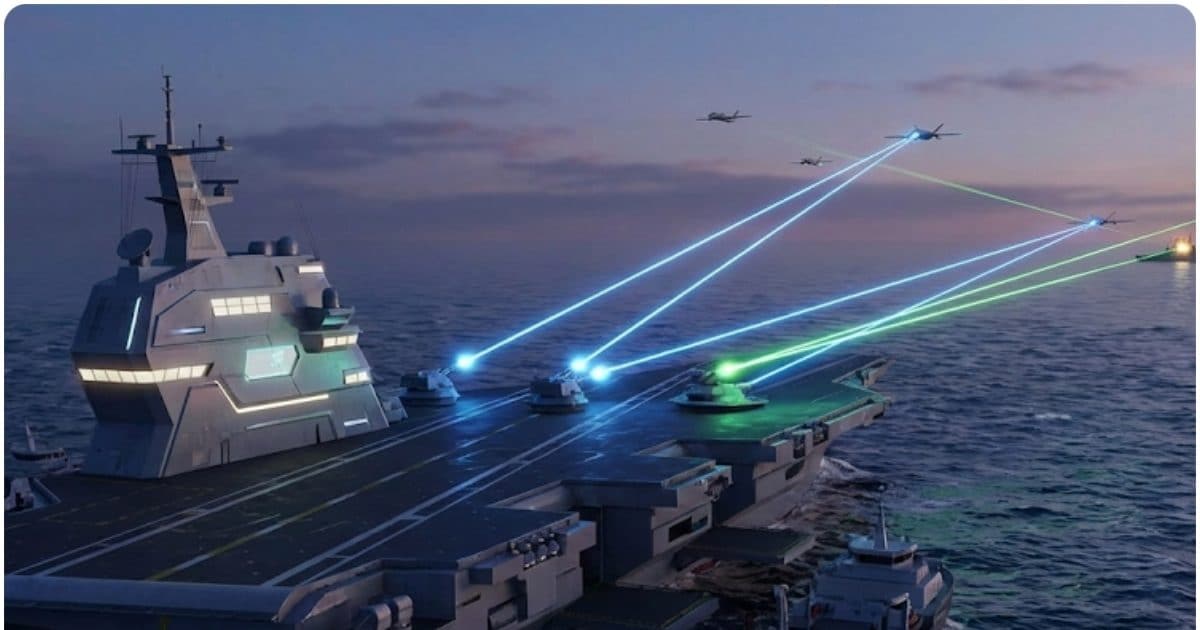
The real focus is the new Trump-class battleships, which are being considered as a game-changer platform for maritime warfare against China. These ships will be fitted with hypersonic weapons as well as high-powered laser systems, which can blind Chinese drone swarms, sensor networks and missile guidance systems in seconds.
As China develops a strategy relying on drones, saturation attacks and electronic warfare in the South China Sea and Taiwan Strait, laser weapons are becoming the perfect answer for the US – no fear of running out of ammunition, no need for reloading, and attack at the speed of light.
The successful deployment of the HELIOS laser system on the USS Preble and its operational test in 2025 is an indication that America is no longer just warning China, but has fielded combat capability. Lasers like ODIN are already deployed to disable enemy ISR (Intelligence, Surveillance, Reconnaissance) systems.
Under the new ‘Fighting Instructions’, the US Navy is creating a dedicated Directed Energy strategy to make laser weapons the permanent backbone of the fleet. This simply means – in the future war against China, American ships will attack with lasers before missiles.
This is not just a technology upgrade, but a strategic announcement to stop China’s naval expansion. If this plan is fully implemented, the war in the Western Pacific in the coming decade will be fought less with missiles and more with laser beams – and the first casualty of that war will be China’s network-centric war model.