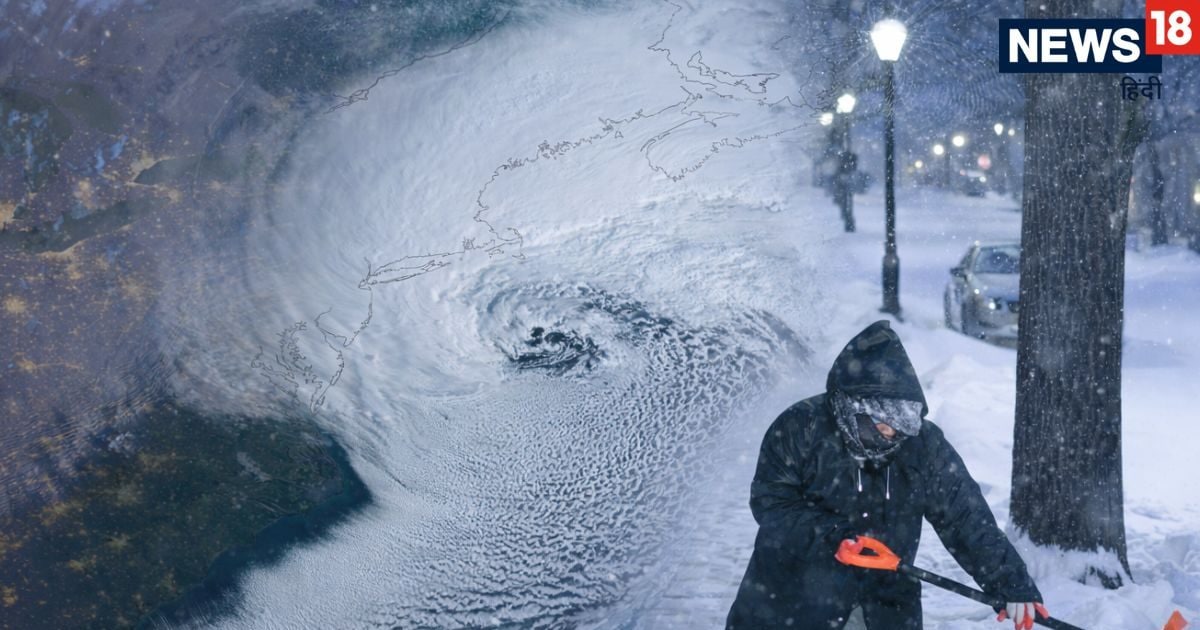
America is currently facing the havoc of nature. A massive winter storm has brought life to a standstill in the north-eastern part of the country. This ‘Bomb Cyclone’, considered rare and extremely dangerous, has covered areas from Virginia to Maine in a thick sheet of snow. More than 4 crore people are under the blizzard warning. The skyline of New York City appears covered in snow, while the movement of people on the streets has almost stopped due to heavy snowfall and strong winds. According to experts, this is one of the most powerful storms in the last several decades and its impact is still not over. What is this storm after all? We understand every issue from its cause to effect.
What is ‘Bomb Cyclone’, which has wreaked havoc in America?
In scientific language, a bomb cyclone, called ‘bombogenesis’, is a storm whose intensity increases explosively in a very short time. When the central air pressure of a storm falls by at least 24 millibars in 24 hours, it is classified as a bomb cyclone. The faster the air pressure falls, the more powerful the storm becomes. In simple words, it is like a winter ‘hurricane’. A rapidly rotating low pressure system that draws cold air from the Arctic produces gale-like winds and snowfall so intense that cities’ systems collapse. For a storm to be officially declared a blizzard, it must have winds of more than 56 kilometers per hour, heavy snowfall, and visibility less than one-quarter mile for at least 3 hours. The current storm has crossed all these parameters.
How serious is the situation in America due to this snow storm?
This high-impact bomb cyclone extended from Virginia to Maine. Blizzard warnings are in effect for New York City, Long Island, the Lower Hudson Valley, much of New Jersey and southern Connecticut. Coastal flood warning is also in force in all three states. By midnight local time, more than a foot (about 30 centimeters) of snowfall had been recorded in the Dongan Hills area of Staten Island and conditions were continuously worsening. According to the Meteorological Department, a blizzard warning has been issued simultaneously for all 29 counties in the New York area. Such a situation has been seen for the first time since the historic blizzard of 1996. New York City Mayor Zohran Mamdani declared a state of emergency and ordered the closure of all roads, highways and bridges from 9 pm Sunday to noon Monday. Only essential and emergency services have been exempted.
Mayor Mamdani said, ‘New York City has not seen a storm of this level in the last decade.’ He appealed to people to avoid non-essential travel. 22 ‘warming buses’ were deployed for the homeless and vulnerable, ferrying people to shelter homes across the five boroughs. ‘Code Blue’ has been implemented, under which no needy person will be turned back from the shelter.
Rhode Island, Pennsylvania, Connecticut, Maryland and Massachusetts have also declared emergencies. The governors of New York and Massachusetts have deployed the National Guard. More than a thousand flights have been canceled at New York City’s three major airports – LaGuardia Airport, John F. Kennedy International Airport and Newark Liberty International Airport. Two-thirds of the flights arriving at JFK were cancelled. Regional rail services have also been suspended. More than one lakh consumers in north-eastern America have been deprived of power supply, while experts say that the worst is still to be seen.
Is climate change responsible for this natural disaster?
Scientists have long been warning that even if the number of winter storms decreases due to global warming, the storms that do occur could prove to be more intense and destructive. The ‘Polar Vortex’ i.e. disturbance in the layer of cold air above the Arctic is also being linked to climate change. When it weakens, cold Arctic air is pushed towards populated areas, causing explosive storms.
The storm comes just weeks after the region reeled from another deadly weather system that left more than 100 dead. According to climate scientists, this pattern is now becoming difficult to ignore. New York Governor Kathy Hochul said clearly, ‘The worst is yet to come.’
‘Monster’ like bomb cyclone seen from space
This powerful bomb cyclone hovering near the east coast of America looks like a hurricane in satellite photos. Seen from space, it appears as a giant spiral of dense clouds, with a ‘swirling eye’-like structure visible near the center, especially near New Jersey.
According to meteorologists, this system has intensified very rapidly, which is the special feature of a bomb cyclone. According to current data, the central air pressure has dropped to about 972 millibars, which is usually associated with powerful coastal storms. In some areas, sustained wind speeds have reached 75 miles per hour (about 120 km/h), while gusts have been recorded up to 90 miles per hour (about 145 km/h).
Technically it is not a hurricane, because it does not draw energy from warm sea water. Instead it derives its strength from rapid differences in atmospheric temperature. However, in terms of structure and wind strength, experts are calling it ‘functionally like a hurricane’. Due to the storm being near the coast, the sea has become very rough in New Jersey and the surrounding coastal areas. As it moves north, heavy rains, strong winds and coastal flooding are expected in New York City and surrounding areas.
Emergency officials have urged people to secure light items outside the home and to be prepared for possible power outages. Due to strong winds, tree branches and power lines may fall. Air travel and ferry services may also be affected, while coastal communities have been issued warnings of dangerous waves and erosion.
The Meteorological Department is continuously monitoring the storm through satellites. However, it is estimated that it will gradually weaken after reaching the land, but even after that, strong winds and heavy rains may continue for several hours. Residents of the north-eastern US have been advised to keep an eye on official weather warnings as the powerful Bomb Cyclone heads towards one of the most densely populated areas of the country.