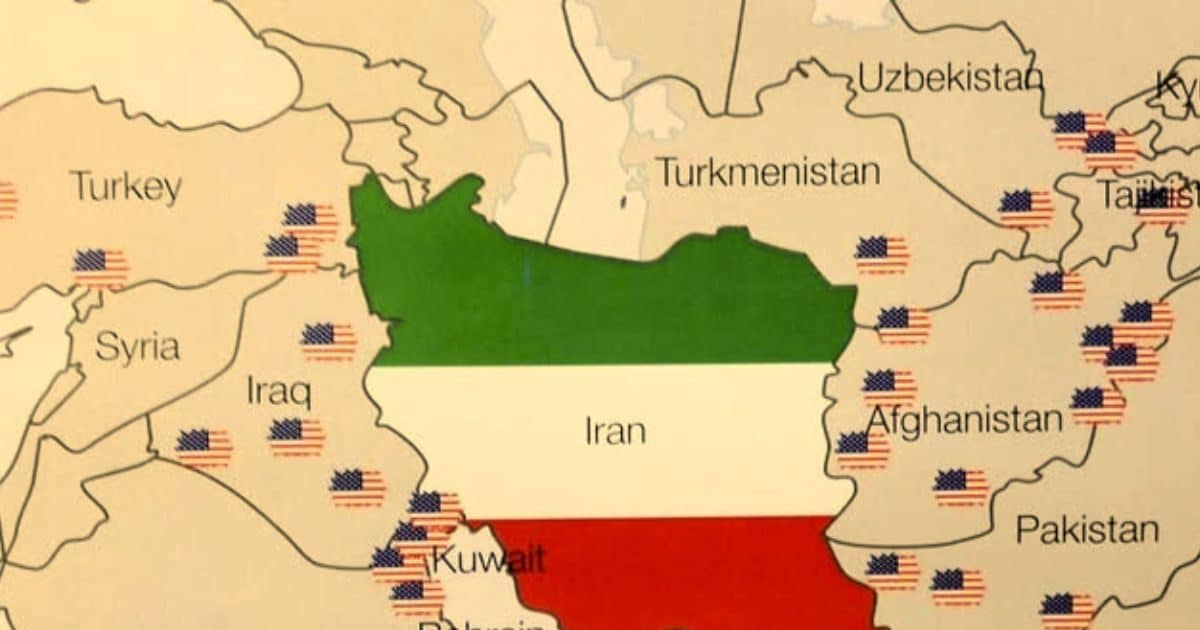
On the surface it seems that America can easily attack Iran, but the ground reality is much more complex than this. Apart from direct war, Iran has proxy forces, missile capability and strategic weapons like Strait of Hormuz. In the event of any attack, oil prices could rise rapidly, American troops deployed in the Middle East could become direct targets and the conflict could spread throughout the region. This fear has forced America to step back again and again. In a special discussion on this main point of News 18, Major General Shashi Asthana (Retd.) presented a very accurate and practical analysis.
Change of power in Iran is not America’s responsibility
Major General Shashi Asthana believes that in fact one thing has become completely clear in America’s mind, if Iran is attacked and even after that there is no change in power there, then it will prove to be a strategic disaster for America. The limited attack that took place in 2025 targeted only the remaining nuclear facilities. For this reason, Iran also did not use its full military potential. Only a small part of the missiles and options it had were used.
But the attack which is being discussed now was to take place keeping in mind the change of power, this is the point from which the risk has increased manifold. It is widely believed in Iran that if there is a direct attack on the existence of Khamenei or the Islamic regime, it will become a “survival war” for them. In such a situation, Iran will respond with its full force. In that situation, American military bases present in different countries of the Middle East will not be safe. Iran’s missiles are capable of reaching there, and this creates the possibility of huge loss of American life and property. America could take such a risk only if it was confident that 100% power change would be successful. But the ground situation cannot give this assurance.
The Iranian regime has proved that it has the full capacity and will to crush internal opposition. Whether through sticks or bullets, control over the protests has been established. This sent the message that power was still firmly in place.
Second, the popularity of Shah’s son and Crown Prince Reza Pahlavi is not wide enough to lead any major mass movement within the country. There is no credible and organized opposition leader in Iran who can emerge as an alternative to power. The most decisive aspect is that the Iranian people may be angry with the poor economy and religious authority, but the hatred towards America and Israel is much deeper. In such a situation, people do not see any external intervention as “liberation” but as “invasion”.
Reinforcing this narrative, the Iranian regime has been claiming that it is targeting spies, traitors, and traitors, not civilians—in an attempt to legitimize its repression. Another major turning point in this entire equation came when Israel itself indicated to America that it was not ready for a war of this level.
If Iran responds with full force—particularly with ballistic and potentially hypersonic missiles—small and populous Israel could suffer significant losses. It has already been seen that on some occasions Iron Dome failed to stop all the missiles. Considering all these reasons, America has taken a step back for now, but this does not mean that Iran has become completely safe.
Attacking Iran is not in America’s favor. Iran is no ordinary country—it has a vast arsenal of missiles and drones, and its geographical location makes it extremely influential strategically. Be it the ability to damage Saudi oil infrastructure or create regional instability—Iran has no shortage of options.
Attempt to repeat Bangladesh spread in Iran
America’s attempt was to incite internal discontent so much that the regime would collapse under its own weight, and then bring about a change of power by injecting a little “external spark”. In a way, this was an attempt to repeat the “Bangladesh Model”.
In Bangladesh, the army was with Sheikh Hasina, but it did not help much, which made the change possible. The situation in Iran is completely different. The Islamic Revolutionary Guard Corps (IRGC) stands fully with Supreme Leader Khamenei. They are ready to fight at any cost to protect the regime. According to Major General Asthana, if there is an attempt at regime change, the IRGC will use all missiles and resources, due to which America may have to suffer heavy losses.
The biggest threat to America is the massive deaths of American soldiers and civilians. If the attack results in more casualties, no one will forgive Trump—especially considering the mid-term elections to be held in November 2026. This “cost-benefit” analysis fails in their calculations: the risks are too high, the benefits too low. Therefore, it seems more practical to stick to limited attacks (e.g. on nuclear facilities in 2025) rather than a major operation involving complete regime change.
Iran’s action against Mossad and CIA agents in Iran
In recent years, Iran has charged, arrested and executed many people associated with Mossad (the Israeli intelligence agency) and the CIA. According to Major General Asthana, their number could be much higher – in the thousands. Although there are no exact figures (as it is an intelligence matter and based on estimates), many people have been “bought” despite Iran’s strict religious system.
Despite the strictness of religion in Iran, economic crisis and dissent lead some people to come into contact with foreign agencies, but the regime is able to suppress it. According to recent reports, Iran has arrested hundreds of people accused of being “Mossad agents” or spies, and many have been executed. Trump’s policy of “don’t fear, don’t kill” is driven less by human love but more by the safety of his CIA and Mossad agents—because their deaths cause huge damage to the American intelligence network.
The Trump administration threatens to attack Iran, but ground realities hold them back. An easy “Bangladesh-like” transition is not possible due to the regime’s strong IRGC support, proxy forces, missile capabilities and internal control. The US knows that a failed attack could wreak strategic havoc—especially in an election year.
Major General Shashi Asthana (Retd) holds a PhD in International Affairs and has 45 years of experience in the Indian Army and extensive experience in the United Nations. He has been a former Director General of Infantry in the Indian Army. He participated in various important operations, including the Kargil War, United Nations Peacekeeping Mission in Ethiopia and Eritrea (UNMEE), and counter-insurgency operations in Tripura.