Last Updated:
Donald Trump Iran Attack Legal or Illegal: After the American attack on Iran, a big question has arisen whether President Donald Trump has crossed the American constitutional limits. The US Constitution gives Congress the right to declare war, while Trump cited that a major threat may emerge soon, so caution is necessary. A serious debate has erupted over the legality of this action under international law and the War Powers Resolution.
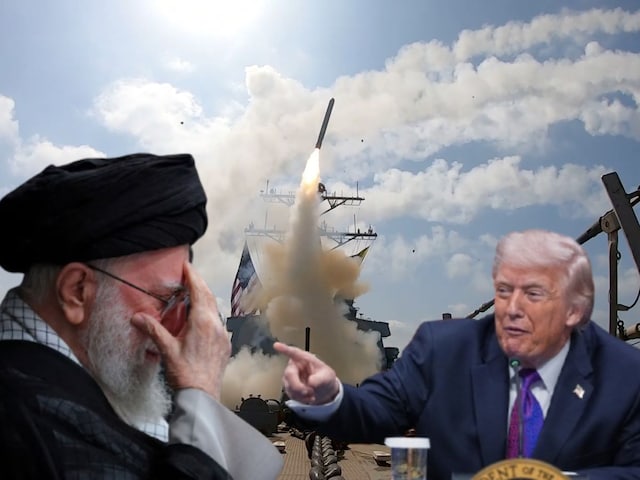

Did Donald Trump cross constitutional limits by attacking Iran? (Photo AP)
US-Iran War Updates: The war in the Middle East is becoming more intense. Israel, America and Iran are bent on destroying each other. As the war progresses, the attacks are becoming more dangerous. However, after the attacks on Iran by America and Israel, the biggest question arising is whether US President Donald Trump has crossed the limits of his constitutional rights? Trump claims that this attack was carried out to eliminate a serious threat to America. But critics say that such military action without Congress’s permission is like crossing the ‘Lakshman Rekha’ of the US Constitution. This is the reason why this issue has now become not only a political but also a legal crisis.
Trump claimed that Iran can acquire nuclear weapons within a month. (Photo AP)
Let us understand the answers to all these questions in 10 points:
- Trump said that Iran was preparing to attack America and its military bases. According to him, the action was ‘immediate and decisive’ to prevent a major threat. However, he did not publicly share concrete intelligence evidence that would corroborate this claim. Critics say that carrying out a massive military attack based only on the potential threat gives rise to constitutional debate.
- Under the US Constitution, the supreme commander of the armed forces is the President. But only Congress has the right to declare war. This is the basic constitutional structure. In history, permission was taken from Congress for major military operations such as Afghanistan in 2001 and Iraq in 2003. In such a situation, the question is whether the attack on Iran falls in the same category. Was parliamentary approval necessary for this?
- The War Powers Resolution of 1973 was created to curb the military powers of the President. According to this, any military operation without the approval of Congress will have to end within 60 days. Also, it is mandatory for the President to inform Congress regularly. If this action continues for a long time, the legal challenge may become more serious.
- A bipartisan proposal has been brought in the US Senate. Its purpose is to prevent military operations against Iran unless Congress gives formal authorization. Even though it may be difficult to get two-thirds majority, this step is also being considered as a strategy to bring the MPs on record. This issue has become politically sensitive in the election year.
- According to the Charter of the United Nations (UN), member countries will refrain from the use of force or the threat of force. The only exceptions are in two situations, when the Security Council gives permission or the action is in self-defense. Experts believe that if an immediate and clear attack is not proven, then this action can be considered controversial under international law.
-
In international law, ‘pre-emptive self-defence’ means that if a country feels threatened by an attack, it can take action to protect itself before the attack. Under this, if an attack is about to happen and it is not possible to avoid it, then it can be considered right to attack first. But for this, solid and public evidence is considered necessary. The Trump administration has not yet made such evidence public. This seems to weaken this argument.
- Trump claimed that Iran can acquire nuclear weapons within a month. But before this he had said that the US Army has completely destroyed Iran’s nuclear program. These contradictory statements have further fueled legal and political criticism.
- Legal debate has also erupted over the death of Iran’s supreme leader Ayatollah Ali Khamenei. In 1981, President Ronald Reagan signed an executive order. In this, the American government or its representatives were prevented from being involved in the murder. If this is considered a peace time action then it can be called illegal. But the situation may be different during wartime.
- The legal interpretation will also depend on whether America was formally considered at war at the time. If there was a situation of armed conflict and the target was part of the military leadership, the action may be viewed differently under international standards.
- Ultimately this matter is not just a legal technical debate. This is a test of the balance of powers in American democracy. Does the President have independent authority to take widespread military action or is congressional approval mandatory? This debate may intensify in the coming weeks in the courts, Congress and international forums.
About the Author

Sumit Kumar is working as Senior Sub Editor in News18 Hindi. He has been associated with the Central Desk team here for the last 3 years. He has a master’s degree in Journalism. Before working in News18 Hindi, he…read more