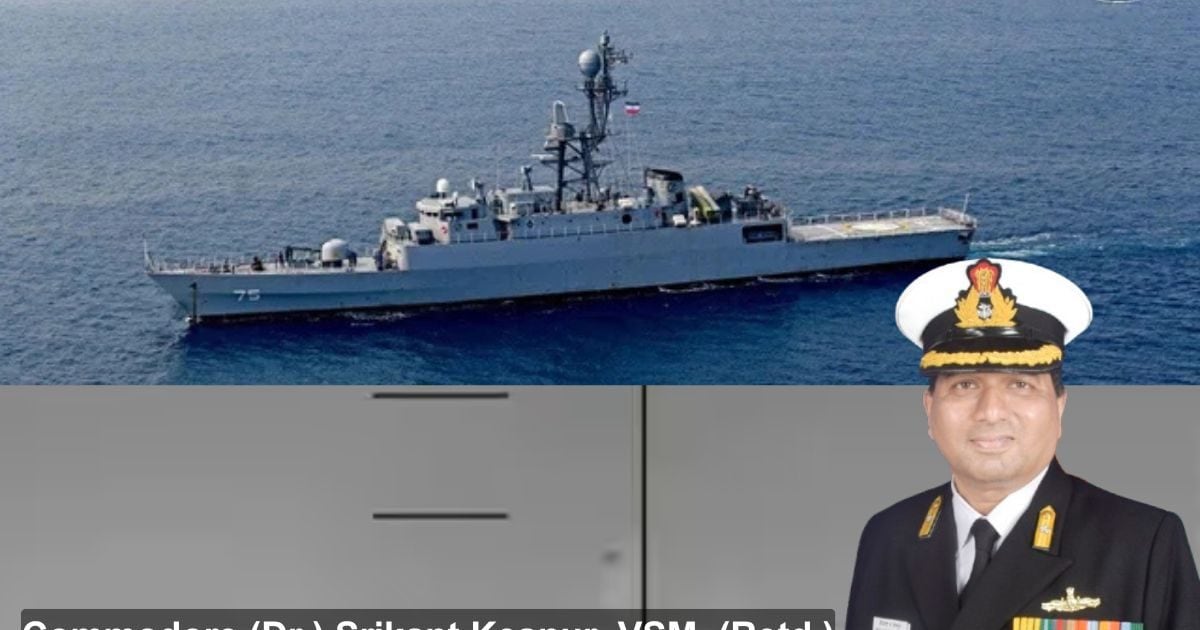
Tension between Iran and Israel-America is at its peak. The United States Navy sank the Iranian warship IRIS Dena in the Indian Ocean on March 4, 2026. After World War II, America sank any enemy ship. This incident raised all kinds of legal and moral questions, because after many years such an incident happened, which was shocking for us. When questions were raised, answers were also found. Like does India have any responsibility in this incident? Should India have been informed before any foreign warship was attacked? What would have been the reaction if this had happened in Indian waters? What does international maritime law say in such cases?
News18 had a special discussion on all these important questions with Commodore Srikant Kesnoor (Retd.) of the Indian Navy. In this discussion, he clarified that India has no legal or moral responsibility under international laws, because this happened in international waters and it is a war between two countries, in which we are neutral. The Iranian ship ‘IRIS Dena’ which was targeted was not in India’s territorial waters, but had left Visakhapatnam seven days ago, which was about 1200 km away in international waters, and had not sought any assistance from India. In such a situation, it is not appropriate to fix any kind of responsibility on India. He said that what the Iranian ship was doing for its country, the American submarine was doing the same, that sailors of any country lose their lives during war, it is certainly tragic from the human point of view. But such results are often seen in war situations.
Commodore Kesnoor also clarified that the United States Navy has no obligation to inform India or the Indian Navy before taking such military action. According to him, during peacetime, information is shared between countries to deal with maritime security, piracy, terrorism or other non-state threats, but when there is an armed conflict going on between two countries, military operations come under the ambit of complete secrecy. If America had informed any third country about such action in advance, it could have affected the secrecy of its military operation and India could have been unnecessarily drawn into that conflict. He said that India’s official stance is to remain neutral in this entire conflict and the Indian Navy works in accordance with the government’s policy. India has important relations with America, Israel, Iran and the Gulf countries, so a balanced and cautious approach in this situation is in India’s interest. When Iranian ship IRIS Lavan asked for shelter from us, we gave shelter in Kochi, Kerala.
In the context of international maritime law, Commodore Kesnoor said that the area up to 12 nautical miles from the coast of any country is considered its territorial waters, which is equivalent to the sovereign border of that country. If any foreign military action were carried out in such an area, it would be considered a direct violation of the sovereignty of that country and India would definitely oppose it. However, the area beyond 12 nautical miles is considered international waters, even if within a country’s Exclusive Economic Zone (EEZ). In such a situation, if two countries are in a state of war, then they can target each other’s military ships in international waters and this is considered legitimate within the scope of international law. The place where IRIS Dena sank was in Sri Lanka’s Exclusive Economic Zone (EEZ), which falls in international waters.
He also said that it is wrong to believe that the Indian Navy or the Navy of any other country can continuously track the movements of every submarine present in the sea. According to Commodore Kesnoor, the ocean is the most complex and opaque area on Earth, where monitoring is extremely difficult. No navy in the world—not even the US—has the ability to track all submarines at all times. We can track the enemy’s naval assets according to threat perception in peacetime. To detect submarines, many resources are required such as sensors installed on the seabed, sonabuoys, helicopters, fixed-wing aircraft and special warships. And even if you do track, will you know about his intentions? No. The Indian Navy has said that navies of about 50 countries operate in the Indian Ocean. Those who are saying that India should have known have never seen a sea or an ocean. It is not possible to monitor the activity of every submarine at all times.
Commodore Kesnoor also clarified that America has not broken any maritime law of any kind. There are two types of international laws, war or use of force is prohibited under Article 2(4) of the UN Charter, but the right to self-defense is reserved under Article 51. Whether war is legal or not is a matter above, but if war starts, then how operations are conducted comes under the “Law of Armed Conflict”. What America has done is almost correct. IRIS Dena was a valid target for the US Navy for submarines.
Commodore Kesnoor also highlighted the increasing role of submarines in modern maritime warfare. He said that the biggest strength of submarines is their stealth capability, that is, they can hide under the sea and attack the enemy suddenly. Often by the time they are discovered, the attack has already taken place. Submarines usually target the bottom of the ship with torpedoes, due to which the effect of the explosion increases manifold. He said that the capability of nuclear submarines is even greater, because they do not need to surface frequently or charge the batteries and they can stay in the depths of the sea for a long time and carry out ambush attacks. This is why countries that have a large number of advanced submarines get a significant strategic edge in maritime warfare.
Giving an example, Commodore Kesnoor said that in case of war, if an enemy ship is present in international waters, then it is legally possible to target it. He also made reference to the Indo-Pakistani War and reminded that INS Khukhri was sunk by a Pakistani submarine during the Indo-Pakistani War of 1971, in which Captain Mahendra Nath Mulla, displaying amazing courage, was martyred along with the ship. The Indian Navy learned many important lessons from that incident and thereafter further strengthened its anti-submarine capabilities, sonar systems and war strategies. According to him, in today’s era, due to nuclear submarines, the nature of maritime warfare has become more complex and dangerous, and this is why submarine power is considered extremely important in modern navies.