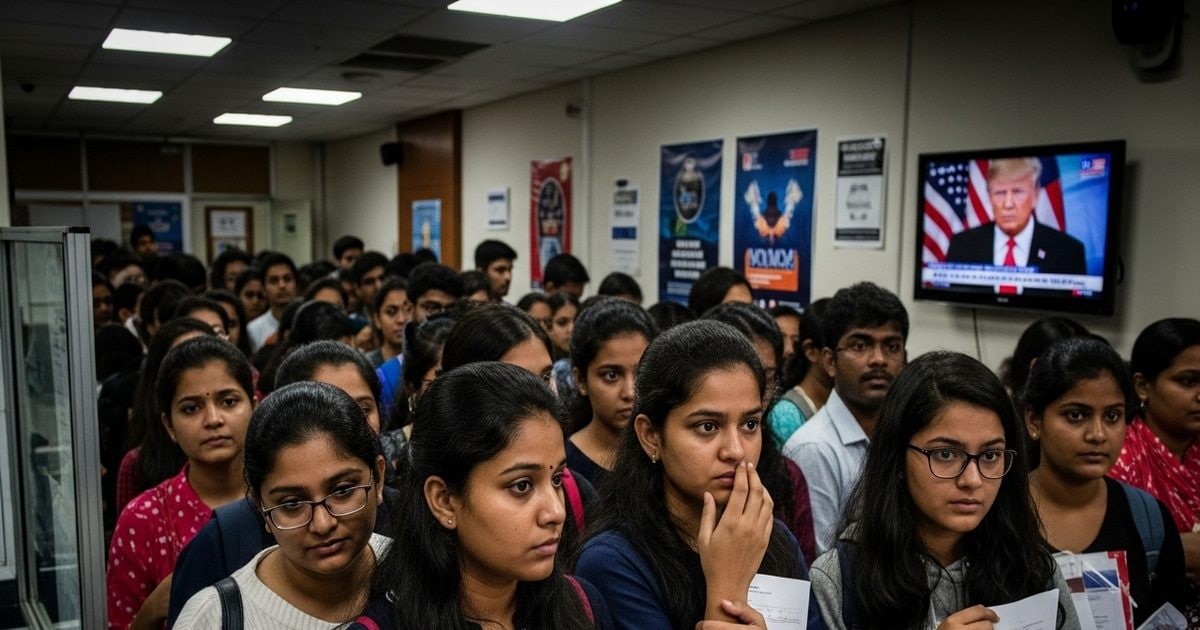
For Indian students who dream of studying in America, the first year of President Donald Trump’s second term (Trump 2.0) has been no less than a shock. According to statistics, enrollment of Indian students in American universities fell by about 75% in the very first year. This decline is believed to be so sharp for the first time in decades. The main reasons for this were the increase in visa rejections, severe shortage of interview slots and fear in the minds of students.
Where is the greatest impact?
Data from Overseas Education Consultancies show that usually the maximum number of students go to America between August and October, but there has been a decline of about 70%. The main reason for this is not getting the visa interview slots on time due to which many students had to postpone their planning at the last moment. Only those students could go to USA who completed their entire application process by February or March.
Visa verification strict, rejection rate increased
Arvind Manduwa of Hyderabad-based consultancy i20 Fever says that this is the first time such a huge decline has been seen. He says that due to strict visa scrutiny, the rejection rate increased and limited slots further intimidated the students. The result was that students became hesitant even in applying to the top 40 American institutions.
Didn’t get relief even from spring session
Many students postponed the admission till spring session (January-March) thinking that the situation would improve but it did not happen. Even during this period, visa slots remained limited and the scope of investigation increased further. Even social media activity was made a part of visa investigation, due to which the anxiety of the students increased further.
The punishment fell on the students also studying
The situation was even more difficult for the Indian students who were already studying in America. According to US State Department data, about 8,000 student visas were canceled by December 2025. Many students suddenly received emails that their F-1 visa status had been canceled and they would have to leave the country in a few weeks. The most frightening thing was that in many cases the reason for visa cancellation was old and resolved cases. The 25-year-old student, who has done Masters in Project Management from Boston, said that there was a challan for overspending in 2024, in which no charge was even filed. Despite this, his SEVIS clearance was canceled, which was later reinstated with the help of a lawyer.
Threat looms on H-1B visa too
The pressure was not limited to students only. The H-1B visa program also remained at the center of political debate. Proposals like imposing fees of up to $1 lakh and limiting the programs scared both companies and professionals. About 72% of the H-1B visa recipients are Indians, most of whom are associated with the IT sector.
Mass visa cancellations and deportations
According to State Department data, in the last 12 months, about 1 lakh visas were canceled in various categories, a large number of which were of Indians. About 3,800 people were deported in 2025, which is believed to be the highest in decades. Among these also, the number of Indian citizens was the highest.
Job market also increased the problem
Meanwhile, the American job market also faltered. Many companies postponed onboarding, stopped visa transfers and in some cases even canceled job offers. Saif H., 27, who has done MBA from Texas, says that even after clearing the interview, his offer was later canceled.
Social media surveillance also became another reason for tension. Under the new rules, H-1B workers and H-4 dependents were warned to keep their social media accounts public for visa verification. Anti-American posts or critical content were reported to be at risk of visa cancellation or deportation. Additionally, Homeland Security also ended the automatic extension of work permits, which forced people to stop working if they were not renewed on time.
Calls for help increased in Indian embassies
Amidst these circumstances, the number of distress calls in Indian embassies has increased rapidly. Immigration lawyers believe that this uncertainty is not going to end yet. People living in America for a long time have also started thinking again about their future. Aziz Nooruddin, who has been living in America for the last 20 years, says that we pay taxes, contribute to the system, but had never felt so unsafe.
What is the overall picture?
In the first year of Trump 2.0, strict visa policy, increased scrutiny, sluggishness in the job market and fear of deportation have made America no longer as safe and attractive an option for Indian students and professionals as before. This is the reason why the dream of going to America now seems to be fading for thousands of Indian youth.