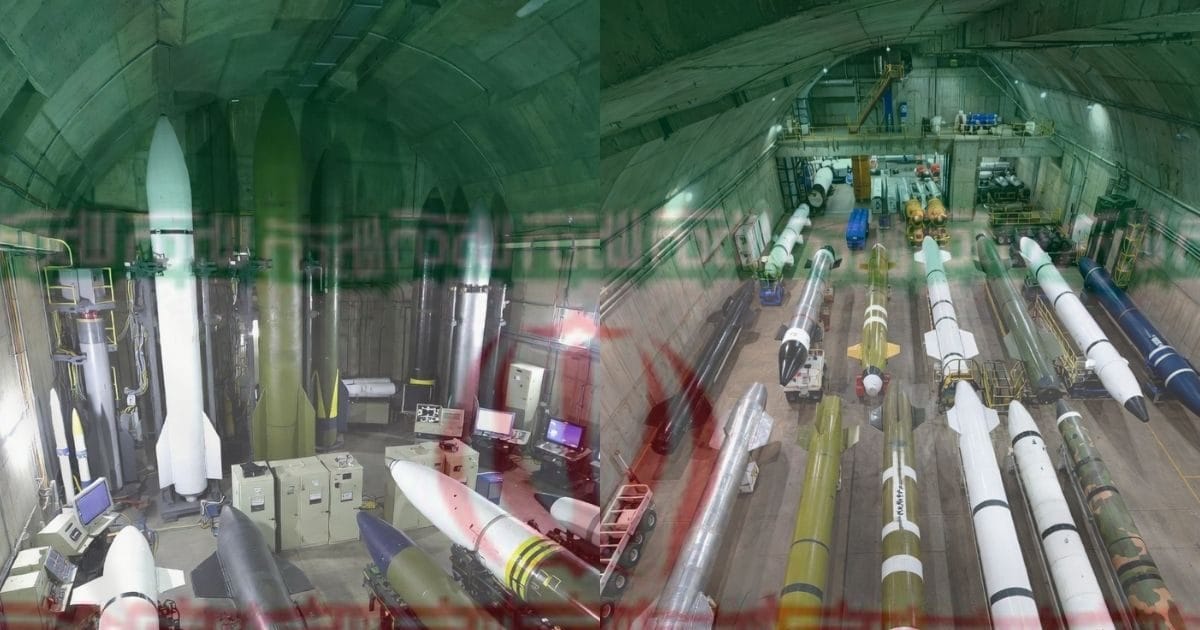
Iran has the largest stockpile of different missiles in the Middle East, despite this Iran has not been successful in threatening or stopping America and Israel. Islamic Revolutionary Guard Corps (IRGC) propaganda videos have repeatedly depicted long-range missiles and underground bases, but in actual confrontations this display of power did not translate into any military gains. This power remained mostly limited to propaganda rather than concrete strategic achievements on the ground.
3,000 ms: Propaganda 100%, Target 0%
In 2022, General Kenneth McKenzie of the United States Central Command said that Iran had more than 3,000 ballistic missiles. Iran fired hundreds of missiles during the short war with Israel in June 2025 and two missile skirmishes in 2024. In response, Israel attacked Iran’s missile warehouses, launchers and manufacturing facilities. By the end of the 12-day war in June 2025, Iran had about 1,500 missiles and 200 launchers.
Iran, Ali Husseini Khamenei always wanted to prepare a strategic counter against the US, only the development of Intercontinental Ballistic Missile (ICBM) could take it forward. Iran’s space program was also helpful in this, because the technology of launching satellites from rockets and the technology of ICBMs are largely similar. Since 2008, Iran conducted two-stage rocket launch tests such as Safir and Simorgh. They can also be used to test long-range missile technology.
Iran has developed short-range ballistic missiles such as Qiam-1 and Fateh-110. It has also claimed to increase the range of Shahab-3 and has talked about deploying solid fuel Sejjil missile. In 2015, Iran reported testing the Emad-1, which it says is a more accurate long-range missile. Later it also introduced Khorramshahr-2, which was said to be its most lethal long-range missile. Apart from this, Iran was also developing a ground-launched cruise missile (LACM), which is designed for precision attack on enemy targets.
1. Iran’s missile ‘kill-chain’ incomplete
Having a large stockpile of weapons and using them effectively are two different levels of capability. Ballistic missile operations depend not just on launch capability but on the reliability of the entire ‘kill chain’. That is, target identification (ISR), real-time intelligence, precise target engagement, secure command-and-control, satellite/navigation support, electronic warfare cover and battle-damage assessment. If coordination among these links is weak, the number of missiles does not translate into strategic results.
Iran’s Islamic Revolutionary Guard Corps (IRGC) struggled to convert this coordinated structure into a decisive advance. Missiles were fired in the direction of residential and military areas, but little strategic effect (deterrence by punishment or deterrence by denial) was achieved. Iran’s missiles and drone attacks have targeted airports, luxury hotels and other civilian targets in the Gulf region. Attacks were carried out on Bahrain, Iraq, Jordan, Kuwait, Qatar, Saudi Arabia, UAE. There is strong anger in the Gulf countries after these attacks, Saudi Arabia talked about taking necessary steps for its security.
This has been called a “shoot in the dark” because there was no clear connection between target-selection priority and expected military outcome. In historical context it is compared to Germany’s V-2 rocket campaigns, which fell on British cities including London. They were technologically advanced, but were mostly designed to exert psychological pressure rather than produce decisive military results. Similarly, if missile attacks do not cause tangible damage to the adversary’s command, air power or logistics lines, they send signals but do not provide decisive gains. The question is not about the number of missiles, but about network-centric warfare, accuracy (CEP), survivability, and escalation-management.
2. Use of wrong weapon on aircraft carrier
If you understand carefully, you will come to know that Iran, Islamic Revolutionary Guard Corps (IRGC), is using its missile capability wrongly. Use of wrong missile on wrong target. According to the IRGC, it targeted the American aircraft carrier USS Abraham Lincoln with four ballistic missiles. IRGC claimed in the announcement issued regarding Operation “True Promise 4”. However, the US Central Command has completely rejected this, ‘Lincoln was not injured, the missiles launched did not even come close’.
Ballistic missiles are generally made to carry nuclear missiles. If we look at another example, the question becomes deeper whether the Islamic Revolutionary Guard Corps (IRGC) is using its missile capability correctly from a strategic point of view? The use of the “wrong missile at the wrong target” raises questions about strategic efficiency. Conventional ballistic missiles were originally developed to carry high-explosive or tactical (in some cases nuclear) warheads over long ranges. Their use is generally considered more suitable for targeting large stationary targets, such as airbases, military structures or strategic targets.
Engaging constantly moving targets at sea, especially high-security and multi-layered defense platforms such as aircraft carriers, is technically more complex and requires extremely accurate real-time tracking, guidance and network-centric support. Any country will generally use anti-ship missiles, especially sea-skimming cruise missiles, to attack sea targets such as the USS Abraham Lincoln. These missiles fly at very low altitudes above the sea surface, avoid radar and use active radar/infrared guidance in the final stage to accurately hit the target.
In contrast, conventional ballistic missiles fly on a high ballistic trajectory. Their effective use on a fast moving aircraft carrier at sea and equipped with multi-layered air defense is much more technically complex. If we look at this claim, Iran has become psychologically weak and in a hurry to project power is using the wrong weapon.
3. Psychologically weak, what can’t he do if he dies?
Has Tehran, trapped under psychological pressure, reached the stage of ‘killing what can’t be done’? In the attacks of 28 February and 1 March, not just one or two targets but strategic and civilian targets spread across the Gulf region were targeted. Iran firing missiles everywhere, the interception near Erbil in Iraq, the damage to Kuwait’s Ali Al-Salem airbase, the targeting of Qatar’s Al Udeid airbase, the sound of attacks in Bahrain’s capital Manama, the explosion near Dubai International Airport in UAE and drone attacks on Oman’s ports – all these show that the scope was regional. There are also reports of explosions near Riyadh in Saudi Arabia and claims of targeting the headquarters of the US Navy 5th Fleet.
This pattern shows that the attacks were not just to change the military balance, but to create an atmosphere of insecurity in the entire Gulf region. The simultaneous targeting of civilian infrastructure, airports, hotels, ports and military bases represents a strategy of “area-wide signaling”. Overall, the force projection of Iran’s stockpile of 3000 missiles was 100% and achievement was 0%.