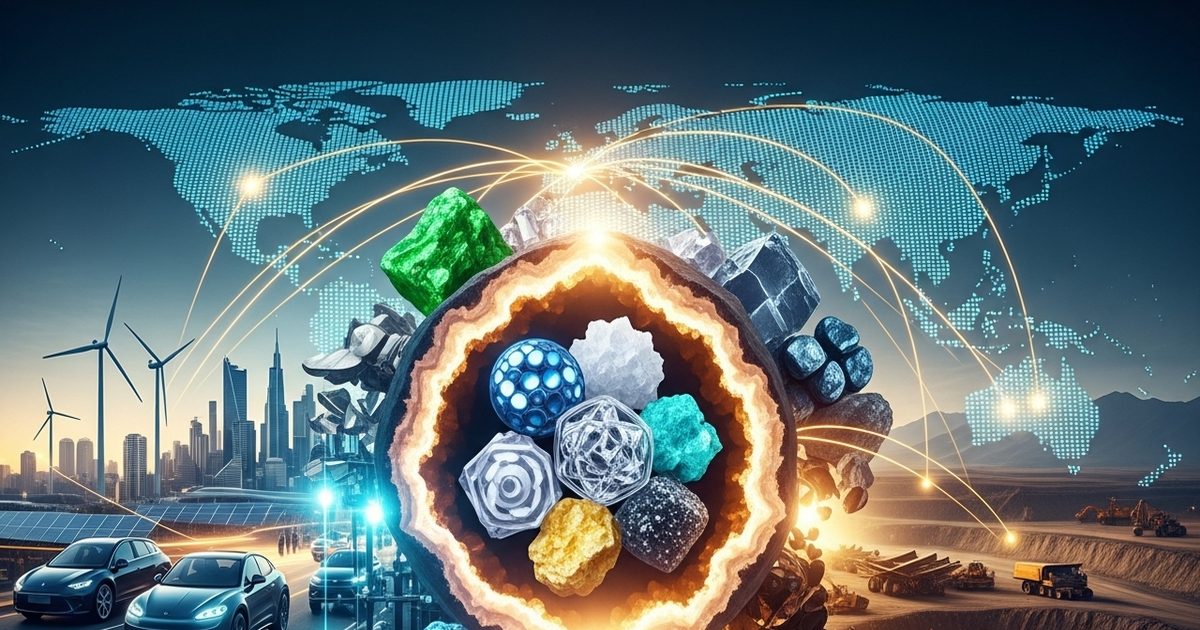
Recently, a big Critical Minerals Ministerial meeting was held in America, in which Foreign Minister Dr. S. Jaishankar participated. America has created this Forge Alliance i.e. Strategic Resources Cooperation Platform to counter China so that China’s monopoly of rare earths can be challenged across the world.
This is an organization of 55 countries. India is also especially included in this. After all, what will this organization do? What will be India’s role in this? Suddenly the role of rare earth i.e. critical minerals has increased in the world.
What are critical minerals, different from rare earths?
Critical minerals are minerals that are important to a country’s economic development, national security, and advanced technologies, but their continued availability is at risk due to limited availability or risks in the supply chain.
Rare earth elements are a group of 17 specific elements of the periodic table, such as lanthanum, cerium and neodymium, which are used in electronics, electric vehicles and defense equipment. These are also a part of the critical minerals, but the category of critical minerals is broader than this – all rare earths are critical, but not all critical minerals are rare earths.
Which metals are included in critical minerals and which are included in rare earth. What is their function?
– The Government of India has released the official list of 30 Critical Minerals, which includes several metals and elements that are important for renewable energy, electronics and defence. Most of these are metals, while some are also non-metals.
Critical Minerals (List of India) –
Cobalt – Electric Vehicle Battery, Superconductor
Copper – Electric Wiring
Nickel – Stainless Steel, Battery
Lithium – rechargeable battery
Molybdenum – steel alloy
Niobium – Superconductor, Steel
Titanium – Aerospace, Medical
Tungsten – Cutting Tools, Filament
Vanadium – Steel Strengthening
Cadmium – batteries, pigments
The full list also includes beryllium, bismuth, gallium, geranium, hafnium, indium, platinum group, rhenium, tantulum, tin, zirconium etc. Whereas rare earths are a subset of critical minerals.
Rare Earth Elements – Rare earths are part of critical minerals. These are a group of 17 lanthanide elements, which are not rare but their processing is difficult. Lanthanum, cerium, praseodymium, neodymium, and samarium are the main ones.
Heavy Rare Earths – Europium, Gadolinium, Terbium, Dysprosium, Holmium, Erbium, Thulium, Lutetium, Yttrium, Scandium.
What is Forge Allianz and what will it do?
Forge Allianz is not an old alliance, but a new international economic security initiative launched by the United States and its partner countries for rare earth supply chain and cooperation. This initiative seeks to stabilize, diversify and secure the supply chain of critical minerals around the world, i.e. minerals used in high-tech, defense, electronics and advanced technologies like electric vehicles.
Was this alliance formed to end China’s monopoly on rare earths?
– Yes, it can be said but the matter is not limited to rare earth only. The main objective of Forge Alliance is to break the monopoly and dominance that China has created over the global supply chain of critical minerals. Rare earths are the most talked about part of it, but they are not the only ones.
What is China’s real supremacy?
– China’s strength lies more in their processing than in ground minerals. However, 60 percent of the world’s rare earths are mined there. 90 percent of its processing and refining also takes place in China. Lithium, cobalt, graphite, magnets – China is in a decisive position in all. This is the reason that if China stops the supply or changes the conditions, then EVs, semiconductors, missiles, drones, wind turbines all can get stuck.
So what is FORGE Alliance actually for?
– America and its partners have openly said that there is a problem, in this case China’s monopoly creates the problem. For this reason, Forge was formed to break China’s monopoly on critical minerals. Forge has three real goals
– Reducing dependence on China
– Spreading mining + processing + manufacturing in different countries
– Freeing the supply chain from political pressure
Therefore, this alliance covers not only rare earths but all important minerals like lithium, cobalt, nickel, graphite, copper.
So can we call this an “anti-China alliance”?
– Not in diplomatic language but yes in geo-political reality. America, Europe, Japan, India all said that this is not anti-China but an initiative to empower itself. However, the fact is that if China had not dominated, there would have been no need for forge.
Why is this important in the context of India?
– India itself has acknowledged that excessive dependence on one country in rare earth and battery minerals is a strategic risk. For this reason, Jaishankar supported this initiative and said that diversification of supply chain is no longer an option, but a necessity.
What will Forge do now between member states?
– This will accelerate cooperation between member countries at policy-making, investment and project level. Will create a stable supply network of minerals. The need for critical minerals is continuously increasing across the world.
Which countries are the members of this forge?
– Main international members – America, Canada, Australia, New Zealand, Britain and European Union. This includes Latin American countries. India, Japan, South Korea, Malaysia, Thailand, Philippines and Kazakhstan are included in this from Asia.
How is India’s participation increasing in Forge?
– Earlier, India was only a source of minerals, now it is increasing participation in areas like global policy cooperation, technology partnership, supply-chain security.
What is the status of critical minerals and rare earths in India?
– India has one of the largest rare earth reserves in the world, it has up to 6.9 million tonnes of monazite mineral, which contains many rare earths. These reserves have been found mainly in states like Odisha, Andhra Pradesh, Kerala, Tamil Nadu and Madhya Pradesh. The government has also discovered huge new reserves. India is on top in the world in terms of resources.
What is the processing and refining capacity in India?
– India is not yet strong in processing and refining, especially at the advanced technological level. Modern and commercial-scale processing capacity for high-purity battery-grade lithium, rare earth magnets, etc. is very limited. There is a lack of modern plants for high quality refining. This means that India has sources of minerals but it is still lagging behind in modern processing-refining.