What was our ancestor like 600 million years ago?
- About 600 million (60 crore) years ago, our ancestor was a small insect-like creature. It lived in the depths of the sea and filled its stomach by filtering plankton from the water.
- The surprising thing is that the lifestyle of this creature was very peaceful. He was a creature who stayed in one place. Scientists believe that before this period this creature probably had two eyes.
- But as its lifestyle became sedentary, it no longer felt the need for two eyes for hunting or survival. The result was that during the process of evolution he lost both his eyes.
How was that single eye in the middle of the head formed?
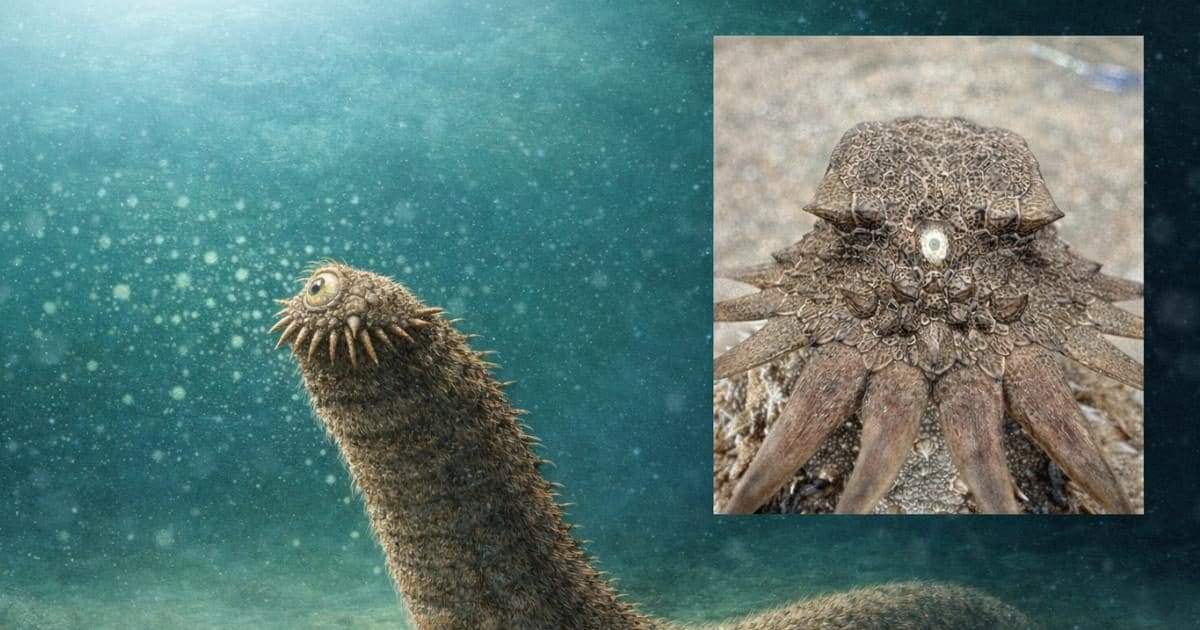
When this creature lost its pair of eyes, a group of light-sensitive cells remained in the middle of its head. This group took the form of a primitive ‘median eye’ i.e. an eye in the middle of the head.
The light spot in the middle of the head of this lizard forms the middle eye. The regular eyes of the animal are not visible because the photo is taken from behind. (Image Credit: Bruno Frías Morales/iNaturalist/Creative Commons)
This eye could not see clear images like the eyes of today, but it understood the difference between day and night very well.
With the help of this only eye, that creature was able to know what was above and what was below. This was a kind of natural sensor which helped it survive in the darkness of the sea.
How did the journey of human eyes begin again?
- After millions of years, our ancestors again adopted an active lifestyle. He started swimming and hunting in the sea. Now he needed eyes that could see clearly and judge distance.
- Research It tells that two new eyes developed again from parts of the same median eye. This is the reason why human eyes are completely different from the eyes of insects or squid.
- Professor Nilsson explains that the retina of our eyes has developed from a part of the brain. On the other hand, the eyes of insects are made of the skin on the sides of their heads.
Due to frequent changes in lifestyle, the eyes of vertebrate animals have developed unique. (Graphic Credit: Current Biology (2026). DOI: 10.1016/j.cub.2025.12.028)
What is the connection between the pineal gland and the ‘third eye’ of the brain?
The most exciting thing is that that eye of our one-eyed ancestor is still present in our body. In the course of evolution, that eye moved away from the face and went inside the brain and became the ‘Pineal Gland’. Today this gland produces melatonin hormone in our body.
This is the same hormone that controls our sleep and wake cycle (Circadian Rhythm). It is mind boggling to think that your sleep today is connected to that one-eyed creature of 600 million years ago.
This study has for the first time explained the origin of the neural circuits that analyze images in our retina.
Scientists analyzed the light-sensitive cells of all animals around the world and examined their position. This proved that the path of our eyes has passed through a special ‘detour’ i.e. a curved turn.
If that ancestor of ours had not been born with one eye, perhaps the structure of our eyes and the way of seeing today would have been different.