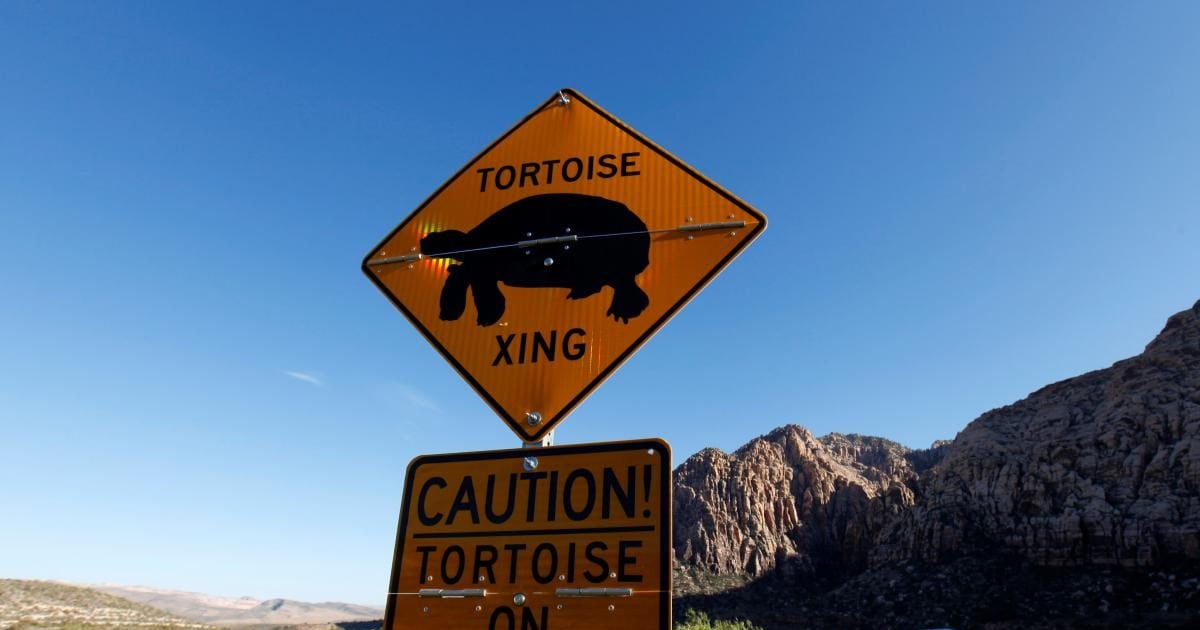
New Delhi: America’s Mojave Desert is known for its vastness and peace. But for the last few decades, it had become the biggest hub of off-roading enthusiasts. Now the hum of engines that used to pierce the silence here is about to subside. A federal judge, Susan Illston, has ordered the closure of nearly 2,200 miles (about 3,500 kilometers) of off-road roads in the Mojave Desert. The biggest reason behind this decision is the ‘Desert Tortoise’, which is now standing on the verge of extinction. According to scientists, these voiceless animals are having to pay the price of human adventure by destroying their species.
Why is this turtle special and what is the danger?
Desert tortoises are considered the ‘keystone species’ of the Mojave Desert. This means that the entire desert ecosystem depends on this one organism. The burrows that this tortoise digs underground are used by other small creatures of the desert to survive and survive. But the sad thing is that since the 1970s, their population has reduced by 96% in some areas.
Off-road vehicles (OHVs) have become a thing of the past for these turtles. When these heavy vehicles run over the rough terrain of the desert, they inadvertently crush the tortoises’ holes. Due to the burrow getting clogged, the turtles suffocate and die inside or they are left with no place to hide. Apart from this, the dust blown by vehicles destroys the vegetation, which these turtles eat to survive.
96% of the turtles are gone! Seeing the scene of devastation in the Mojave Desert, the judge imposed a ban on off-roading. (File photo: Reuters)
What has the court said in its order?
- Judge Illston clearly said in his order that the Bureau of Land Management (BLM) has failed to protect these turtles. The court found that the increased use of off-road vehicles is a major and continuing cause of the decline in turtle populations.
- The judge has given the administration time till 2029 to create a new and safe network of off-road roads. Till then, movement in sensitive areas will remain completely restricted.
However, implementing this decision is not so easy. The administration has only 15 rangers to monitor the vast area of about 50 lakh acres. With so little staff, fencing thousands of miles of roads and stopping people is going to prove to be a big challenge.
‘Cold war’ breaks out between off-roaders and environmentalists
This decision has divided the society into two parts. On one side, there are organizations like ‘Centre for Biological Diversity’, which are considering this as a big victory. They argue that public land cannot be wasted for the entertainment of any one group. On the other hand, the off-roading community says that they are being made scapegoats.
Tourism business worth crores in danger due to California court’s decision. (File photo: Reuters)
Organizations like ‘Blue Ribbon Coalition’ claim that climate change, drought and hunting ravens are more responsible for the death of turtles, not vehicles. This ban will also have a deep impact on the economy of small towns like Lucerne Valley and Randsburg, which are completely dependent on off-road tourism. Many businessmen say that this is like going to a ski town and closing the mountains.
Is it enough to just close the roads?
Experts believe that merely closing the roads is not enough. Turtles face many challenges in the Mojave.
Terror of crows: With human development, the number of crows in the desert has increased wildly, which eat small turtles.
Diseases: Respiratory diseases spread by releasing pet turtles into the wild have also harmed their population.
Solar Energy Project: Big solar farms being set up in the desert are also taking away their natural habitat.
Scientist Ed La Rue says that if we want to bring the tortoises back, we will have to protect parts of the Mojave by completely fencing them, as has been done in the ‘Desert Tortoise Research Natural Area’. There has been an improvement in the turtle population there.
Would the desert survive without tortoises?
From a human perspective the question often asked is, ‘What difference does it make whether a turtle lives or not?’ But the reality is that if these keystone species disappear, the entire chain of the desert will be broken. Without burrows, small animals will die from the heat and the entire ecosystem will become barren. This fight is just to save the balance that makes life possible on Earth.