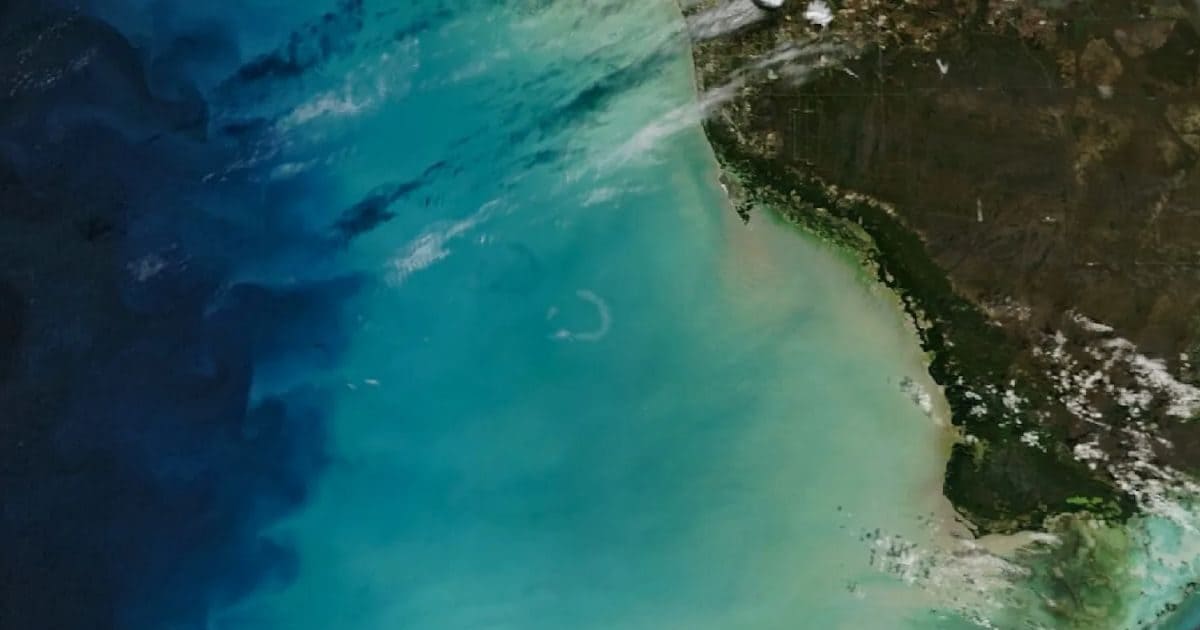
How did the color of the deep blue sea change?
Florida has faced severe cold in late January and early February. The situation was such that due to cold, iguanas were falling from the trees. Meanwhile, on February 3, NASA’s ‘Terra’ satellite observed a change in the color of the water while passing over the West Florida shelf. Investigation revealed that calcium carbonate soil and remains of marine organisms present at the bottom of the sea had come up in the water. Due to this reason the color of water started appearing pale and dull blue. This scene was exactly the same as is often seen after a big storm.
Before and after satellite images show a dramatic change in the color of the water. (Credit: NASA)
How did cold winds create turmoil in the sea?
According to NASA scientists, this historic cold has changed the density of sea water. As the temperature dropped and the winds increased, the shallow water cooled and became heavy. This heavy water started flowing towards the deep sea with the waves and brought the sediment along with it.
Although such incidents are mostly seen during hurricanes or cyclones, but this time the winter storm has also shown the same effect. This process has created a new movement within the ocean, which has now become necessary to understand.
What is ‘Hammerhead’ cyclone?
‘Hammerhead’ Eddies i.e. small cyclones have been seen under the sea in the pictures received from Landsat 9 satellite.
- These cyclones form when cold and dense water collides with the slow flowing water of the Gulf of Mexico.
- This creates curved waves inside the water. Just like physics works in dust storms on Mars or Earth.
These scenes are a big subject of research for scientists. These show how the carbon cycle is changing within the ocean.
The ‘Hammerhead’ eddy is a vortex similar to the one seen in the dust storms of Mars. (Credit: NASA)
Calcium carbonate present in ocean sediments affects the Earth’s carbon cycle. Usually, sea storms carry this debris into deep water, which leads to carbon storage (sequestration). But there is very little research about how this happens during winter storms.
Climate scientists are now trying to understand with the help of these pictures how the oceans are absorbing carbon at the local level.