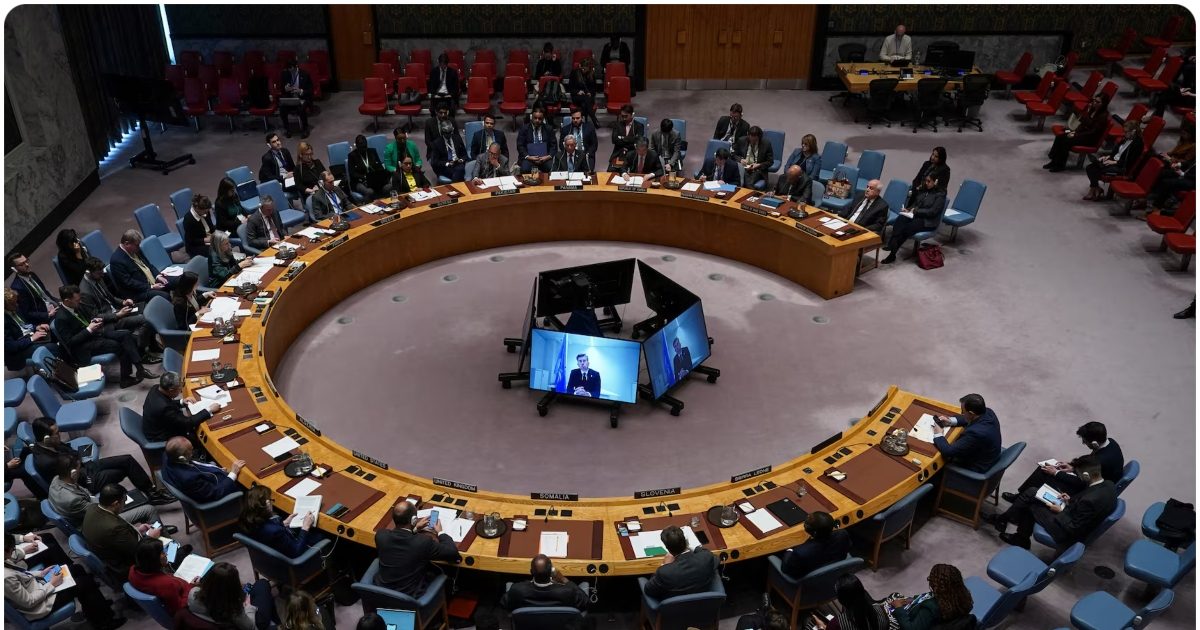
United Nations. There has been a demand for change in the United Nations for a long time. Now G4 countries have issued a warning regarding this. G4 countries say that delay in reforms in the Security Council will cause more pain and suffering to humans. Along with this, G4 also presented a model of early action to recreate the largest decision-making department on behalf of the UN.
Many countries have supported India for permanent membership in the UN. In such a situation, India’s Permanent Representative to the UN, P. Harish, on Wednesday, on behalf of the G4 in the Inter-Governmental Negotiations (IGN) for the reform of the Security Council, said, “Countless innocent lives are being lost every day in the ongoing conflicts, so together we have to make every moment precious.”
Let us tell you, G4 includes India, Brazil, Germany and Japan, who together advocate reform in the Security Council and also support each other for permanent seats in the reformed body. The Indian representative said, “The world is going through times like never before. The credibility and effectiveness of the UN is being questioned as it fails to deal with growing conflicts. For decades, status quo actors have created barriers and prevented progress. In doing so, they are complicit in the failure of the Security Council.”
According to the reform process, IGN is facing obstacles from a small group of countries. These countries call themselves Uniting for Consensus (UFC) and adopt procedural steps to prevent them from adopting a text to move forward in negotiations.
Gianluca Greco, Italy’s deputy permanent representative, stressed that there must be consensus on all issues before a text setting out the reforms can be adopted. He also reiterated the purpose of having UFC. This prevents increasing permanent membership in the UN.
P. Harish said that G4 is clear that negotiations based on a text, with clearly defined milestones and timelines, are at the heart of the IGN process. He said that G4 is committed to working towards a consolidated model as this could be the beginning of text-based conversations.
The Consolidated Model will bring together suggestions from all UN members and present them in a way that helps negotiations. India’s permanent representative described the G4 as a solid model for reforms covering all categories and locations.
He said that the size of the council should be increased from the present 15 to 25 or 26, out of which there should be six new permanent seats. A fundamental principle behind the G4 model is to reflect today’s geopolitical reality. For this, out of six new permanent seats, two should be given to the African region, two to Asia Pacific, and one each to Latin America and Western Europe.
This model includes that India and Japan will get Asia Pacific seats, Brazil will get Latin American seat and Germany will get one seat for Western European countries. Harish said one or two of the new temporary seats would be given to Africa, and one each would go to the Asia Pacific, Latin America and Eastern European groups. He said that in the temporary category, appropriate attention should be given to Small Island Developing States to ensure their correct and continuous representation. G4 is against introducing new seats on the basis of religion.
“Proposals to introduce new parameters such as religious affiliation go against the UN’s existing practice and add considerable complexity to an already difficult discussion,” Harish said. Without naming names, he took aim at the UFC for opposing permanent seats for Africa. Africa’s permanent membership has received the support of most countries.
P. Harish said that G4 has given its formula to remove the old injustice against Africa. One cannot say that they support correcting such injustices and, at the same time, oppose increasing the permanent category for Africa.
Yamazaki Kazuyuki, Japan’s permanent representative, said the Asia-Pacific region is under-represented in the Security Council. It has only five seats, one permanent seat and two non-permanent seats, while the region has 54 UN members and more than half the world’s population.