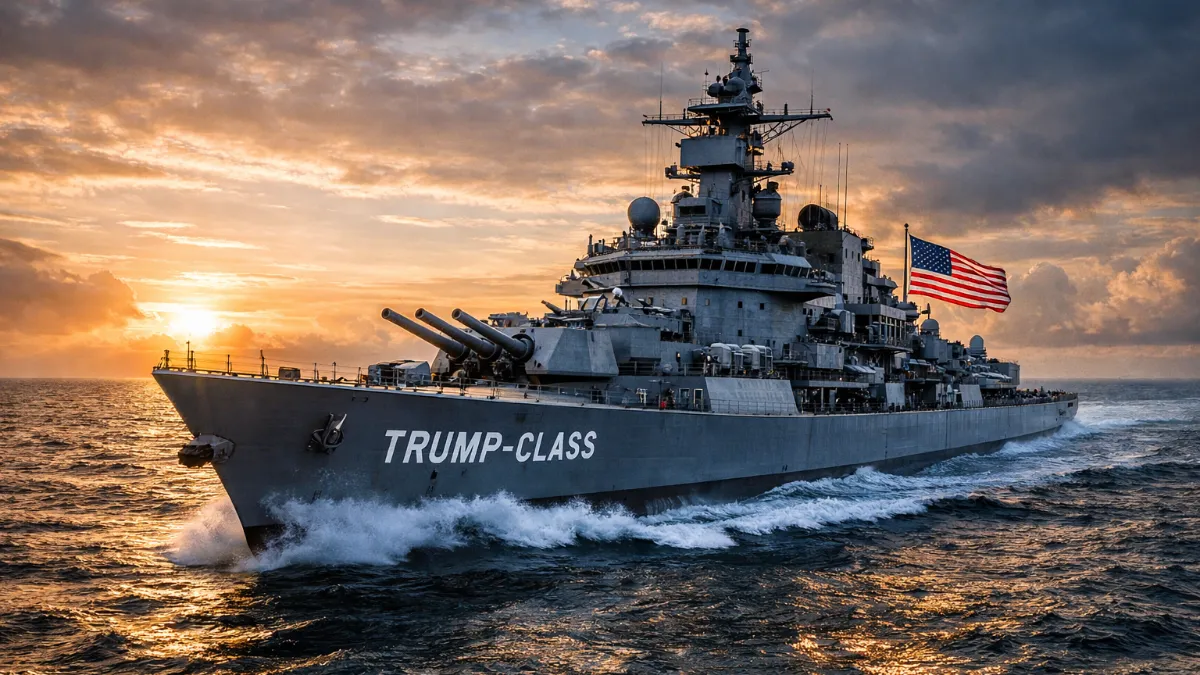
President Donald Trump announces plans for Trump-class battleships, outlining a proposal to modernize the U.S. Navy amid rising global maritime and security tensions.
Washington, D.C. | Dec. 24, 2025 –
Historic Defense Announcement Unveiled
President Donald Trump unveiled a new military project on Tuesday, laying out plans for a new generation of warships that he dubbed “Trump-class battleships,” which quickly generated a national response in terms of debate about this new project and how it fits into the activities of the United States Navy in the years to come. The president made his remarks during a highly publicized address in which he pushed for the upgrading of the United States military.
Vision for the Most Advanced Battleships Ever Built
As per the president, “the Trump-class battleships will mark the cutting edge of surface vessels ever constructed by Americans and would reflect a union of massive firepower, cutting-edge defenses, and new weapon technology precisely to counter today’s threats.” Trump referred to his project of constructing these super-battleships as “big, powerful, beautiful, and unstoppable” because it was a move “to reaffirm American dominance in the face of aggressive competitors abroad who are expanding their own navies.”
Rising Global Maritime Tensions
The development is coming at a time when international maritime security is becoming increasingly complex, with heightened levels of tension present in areas like the South China Sea, the Persian Gulf, and the Arctic. There have also been warnings from defense officials who claim that their rivals have heavily invested in hypersonic missiles, submarines, and anti-ship missiles. Donald Trump fully believed that his Trump-class battle ships would provide an appropriate solution.
Advanced Technology and Hypersonic Capabilities
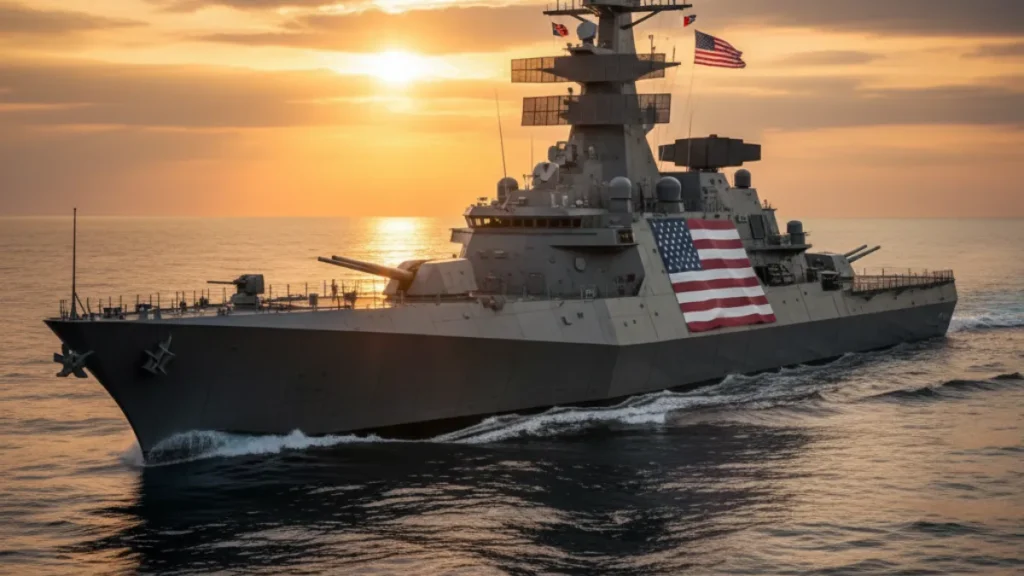
In his address, the president provided his vision on how the new generation of battleships will encompass “state-of-the-art radar, anti-missile capabilities, anti-jam electronics, as well as the ability to attack enemy targets at hypersonic speed.” Although specifics were not provided, Trump said that the ships will also “lead the world in artificial intelligence targeting; advanced command control; and energy-based weaponry that will knock down incoming attacks at rates never seen before.”
A Strategic Shift From Traditional Naval Doctrine
The thought of a new genre of battleships reflects a significant departure from U.S. Navy strategies, which have centered primarily around the carrier, destroyer, and submarine. The traditional battleship was a thing of the past as a result of their affordability, vulnerability, and the advent of aerial warfare. Trump claimed new technology enabled a new vision for battleships.
Trump Defends the Return of Battleships
“A lot of people said the battle ships were dead, and they were wrong,” said Trump. “With the technology we have today, they’re stronger, smarter, and more lethal than ever before.” The Trump-class ships, according to the President, will be capable of functioning in conjunction with existing carrier strike groups.
Cost and Feasibility Questions Raised
Defense observers were quick to point out that the plan raises various questions with regard to its cost, viability, and necessity. It needs to be noted that large surface ships, which are heavily armored and possess enhanced weaponry, would demand considerable investments, which may run into tens of billions of dollars. It was suggested that the money could well be spent on other areas, like submarines, unmanned vehicles, and cyberspace operations.
Supporters See a Strong Deterrence Message
But for supporters of the initiative, the news is more of a statement of intent. For some military stalwarts, the fact that the proposed battleship needs to have so many defense systems integrated into it is an indication that the weapon has the potential to act as a great deterrent, as it shows the capacity to withstand attacks as well as be able to deliver continuous fire support.
Controversy Over Naming the Ship Class
The naming of the proposed class of ships also garnered quick attention. Historically, ship naming within the US Navy is based on established traditions, and battleships have been traditionally named after states. Use of the name of sitting presidents is without precedent in recent American history. President Trump did not directly respond to any of the concerns, choosing to focus on what he believed to be symbolic of American power and leadership.
Republican Praise and Political Support
Political responses were quick to come, but they were highly polarized. Republican supporters welcomed the announcement as proof of strong leadership and commitment to the country’s military security. Members of the legislature stressed the need for the refurbishment of the military as a means of maintaining dominance over its rivals. “It’s peace through strength,” a Republican explained, marking a familiar refrain from the Trump administration’s defense policy.
Democratic Concerns Over Transparency
On the Democratic side, officials expressed worry about transparency and priorities and even possible politicization of military capabilities for political reasons. “We must make sure our military is informed by facts and not brands,” said a critic. Several Democrats urged the Pentagon for extensive briefings and criticized what they saw as ‘ symbolism in procurement policies.’
Cautious Response From the Pentagon
Within the Pentagon halls, there was cautious reaction to such possibilities. Pentagon spokesmen confirmed that there had been initial talks on projected future capabilities regarding naval power but said that final determinations had not been reached on future battleship builds. They pointed out that an extensive review process was necessary before embarking on a significant procurement project such as a battleship build.
Historical Perspective From Naval Experts
This debate has attracted input from naval historians as well, who reminded everyone that battleships had previously dominated the world’s oceans but had lost significance after World War II in favor of aircraft carriers and missile technology. Yet, it has been acknowledged that current technology could make this assessment no longer true.
International Implications and Global Monitoring
International responses brought more complexity to the story. Experts observed that competitors are always keeping tabs on U.S. defense announcements, especially on announcements of broad capability changes. A new American battleship may have an impact on naval development strategies in countries like China and Russia, given that they have invested considerable resources in anti-ship weapons that target U.S. superiority.
Economic Impact on U.S. Shipbuilding
Economically, the proposed initiative is of high importance to the U.S ship-building industry. According to Trump, the initiative has the ability to create jobs because the vessels would be constructed in American shipyards by American workers. His approach was aimed at reviving the ship-building industry as well as the affected community related to the defense industry.
Long Development Timeline and Technical Challenges
Despite the excitement that some circles display, it is rather complex and a process that may take a lot of time for a new generation of warships to be designed and developed. Even large naval ships may take over a decade from conceptualization until they can be commissioned.
Public Debate and Congressional Oversight
Public reaction has been mixed as more information has come out. On one side, there are Americans who see this announcement as a statement of power, but others feel that these big ships do not fit the future of warfare, which seems to be more focused on drones, cyber, and space. This reflects the larger debate on the future of warfare that the United States must face. One aspect that will be important as the discussion continues is the oversight role of the Congress. The Congress will be expected to ask for cost estimates and comparisons to other forms of investment. hearings and legislative budgeting may well decide the fate of the Trump-class battleships: rhetoric or reality. For now, at least, the announcement has been successful in generating interest and reminding everyone of the Trump approach to security. Through his proposal to vastly increase the size of the Navy named after him, Donald Trump continues to put his stamp on the security debate in America, as he does so often by reminding everyone of his own role in America’s security approach. Whether these Trump-class battleships enter as steel and sail or remain as a vision remains a matter for the politicians, strategists, and economists of the future. It remains clear, however, that this recent news has added a new chapter to what many strategists and theorists have considered a dialogue over how the USA can maintain a position as a militarily powerful nation into the twenty-first century.