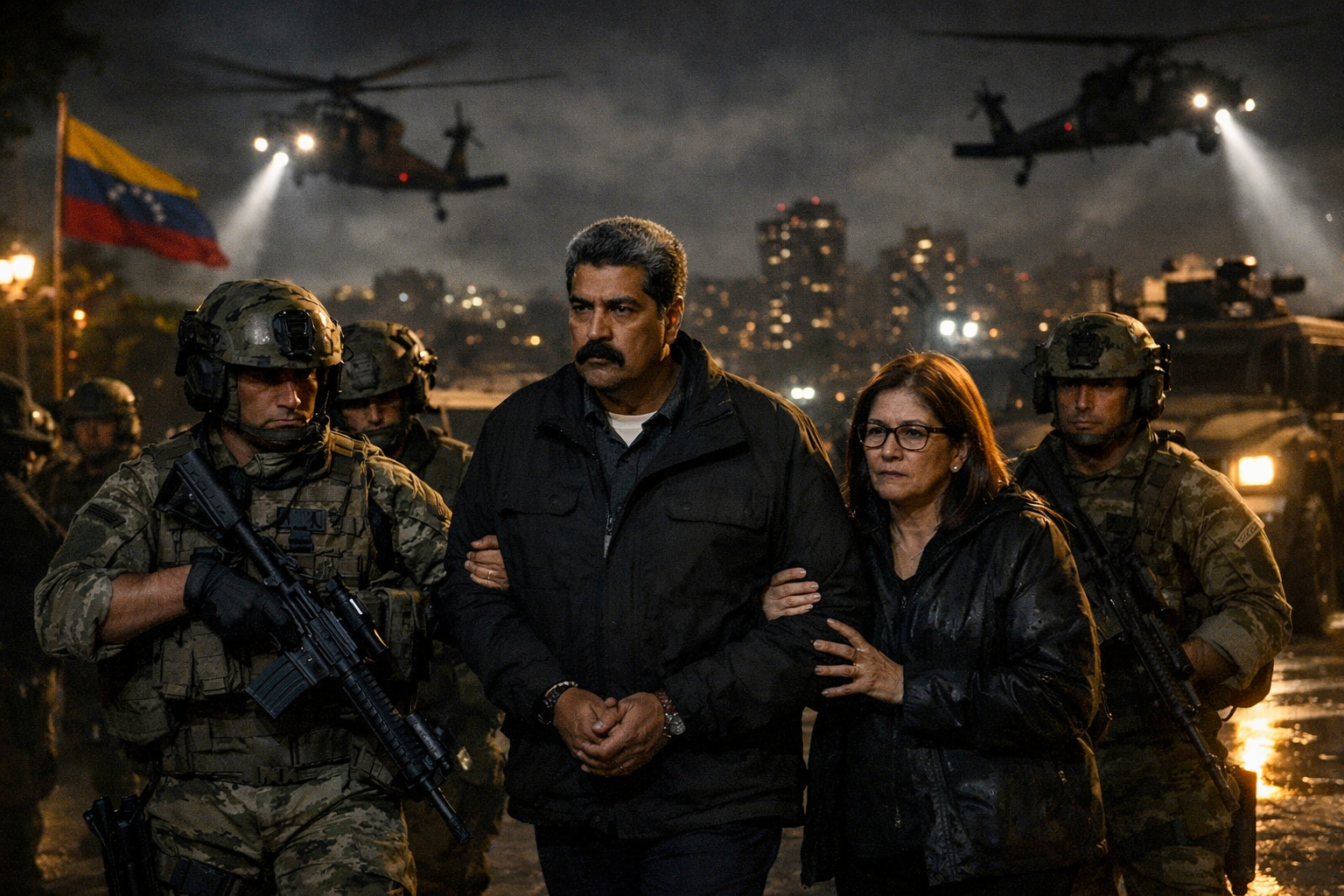
U.S. forces capture Venezuelan President Nicolás Maduro and his wife in a historic operation, raising global legal, political, and regional tensions.
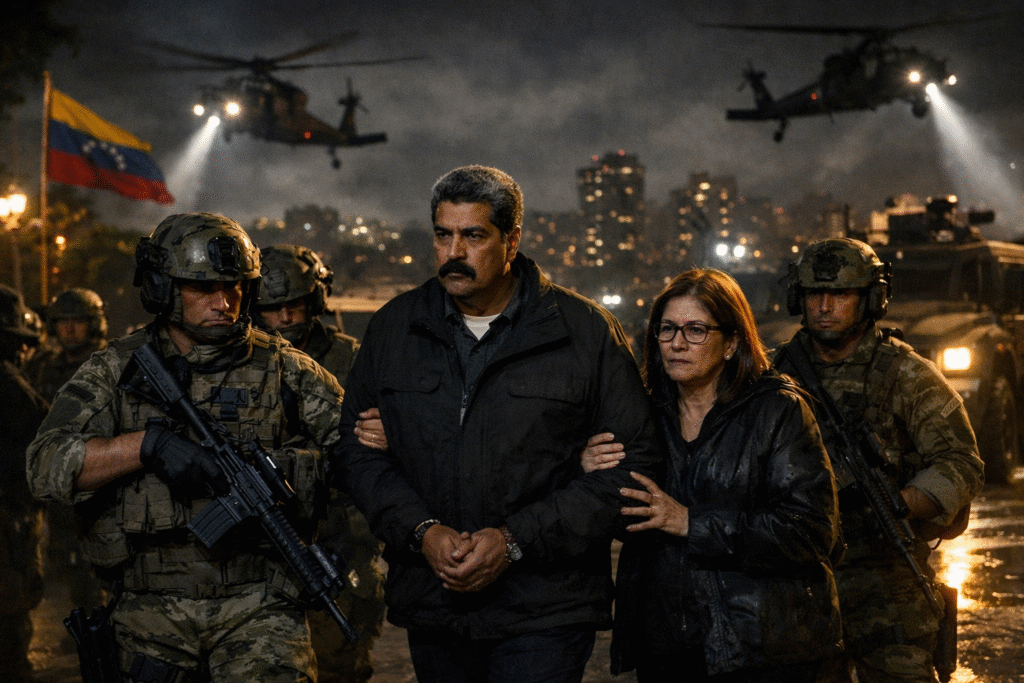
Date: January 3–5, 2026
Location: Caracas, Venezuela
In a stunning and historic move, Venezuelan President Nicolás Maduro and his wife, Cilia Flores, were captured by U.S. military forces over the past weekend and transported to the United States. The dramatic operation — the first of its kind in modern U.S.–Latin American relations — has sent shockwaves across the globe, raising questions about international law, sovereignty, and regional stability.
The operation, reportedly named “Operation Absolute Resolve,” took place in the early hours of January 3, 2026. U.S. forces targeted key government and military locations in Caracas, moving swiftly to detain the Venezuelan leader and his spouse. U.S. officials described the mission as executed with precision and minimal casualties on the American side.
The Raid: How It Unfolded
Multiple reports indicate that the raid began before dawn. Explosions were reported across Caracas as elite U.S. units, including Delta Force commandos, moved in to secure Maduro’s residence. In a televised statement, President Donald Trump confirmed that Maduro and Flores were in U.S. custody and had been flown out of Venezuela.
Venezuelan authorities immediately condemned the operation. Vice President Delcy Rodríguez called it an “illegal kidnapping” and demanded proof of life, emphasizing that Maduro remained the legitimate president of the country. U.S. officials maintained that the operation was necessary to bring Maduro to justice for his alleged criminal activities.
Once in the United States, Maduro and Flores were processed by federal law enforcement and are scheduled to appear in a New York federal court to face charges, including narcoterrorism and drug trafficking conspiracy, linked to Maduro’s alleged involvement in international drug networks.
The U.S. Perspective: Justice or Military Overreach?
The Trump administration defended the operation as a blend of military precision and law enforcement, arguing that Maduro’s regime had become a hub for drug trafficking, corruption, and political repression.
President Trump warned that if Maduro’s government did not cooperate in establishing a transitional administration, the U.S. could launch a second operation, signaling a shift toward temporary American oversight over Venezuelan governance.
Meanwhile, the Attorney General emphasized that Maduro and his wife would face serious criminal charges in U.S. courts, framing the operation as a legitimate effort to uphold justice.
Venezuela’s Political Chaos
Maduro’s capture has left Venezuela in a political and constitutional limbo. Vice President Delcy Rodríguez has declared herself acting president, citing the country’s succession laws. However, her authority is widely disputed, both domestically and internationally.
Venezuelan opposition leaders have expressed willingness to engage in transitional governance talks, but there is no consensus on who should lead or how free elections could be organized. Meanwhile, the military’s loyalty is uncertain, and public sentiment remains divided — some celebrating the end of Maduro’s rule, others decrying the foreign intervention.
Global Reactions: Alarm and Condemnation
The capture sparked an immediate and intense global response.
Cuba, a long-time ally of Maduro, reported that 32 Cuban military officers were killed during the U.S. operation and condemned the intervention as an act of aggression.
Nations across Latin America voiced concern or outright condemnation, warning that unilateral military action undermines the sovereignty of independent states.
Russia and China condemned the operation, labeling it a threat to regional peace and international law.
At the United Nations, diplomats and legal experts debated the operation’s legality. Without UN Security Council authorization or a clear claim of self-defense, critics argue that the U.S. violated the principles of state sovereignty and non-intervention, setting a dangerous precedent for future international relations.
Legal Questions: Sovereignty vs. Justice
One of the most contentious aspects of the operation is its legality under international law. Traditionally, sitting heads of state enjoy sovereign immunity, meaning they cannot be prosecuted by foreign courts while in office.
Some experts argue that using military force to seize a head of state without consent breaches customary international law, regardless of any criminal indictments. They emphasize that domestic charges alone do not justify military action, especially in the absence of extradition agreements or diplomatic consent.
The United States, however, maintains that the operation was necessary to enforce long-standing indictments and dismantle criminal networks operating internationally.
Regional Implications: Latin America on Edge
The operation has reshaped U.S.–Latin American relations overnight. Analysts warn of several consequences:
Political realignments: Countries may reconsider alliances depending on how the U.S. handles Venezuela.
Diplomatic strains: Unilateral military action risks increasing anti-American sentiment.
Economic impact: Venezuela holds some of the world’s largest oil reserves; instability could disrupt markets.
Humanitarian concerns: The region already hosts millions of Venezuelan migrants; escalating tensions could worsen the crisis.
Looking Ahead: Court Proceedings and Uncertainty
Maduro and Flores are expected to appear in a New York federal court in the coming days. U.S. authorities are preparing to prosecute them for alleged drug trafficking and narcoterrorism, while international observers monitor closely how the trial may influence global law and norms.
In Venezuela, the country faces a leadership vacuum, an already fragile economy, and a deeply divided society. The coming weeks will determine whether the U.S. can facilitate a peaceful transition or whether instability will worsen.
For the international community, the operation raises profound questions: Can the United States justify military action against a sovereign leader for alleged criminal conduct? How will this affect global norms, and what does it mean for future U.S. foreign policy in Latin America?
Conclusion
The capture of Nicolás Maduro marks a historic moment in modern geopolitics. It demonstrates the reach and audacity of U.S. military power, yet it also challenges long-standing norms of sovereignty, international law, and diplomacy. For Venezuela, the road ahead is uncertain, fraught with political upheaval and potential conflict. For the United States, it is a bold, controversial move that will shape the discourse on military intervention, justice, and global governance for years to come.
The world watches closely, as the geopolitical map of Latin America and the Western Hemisphere has changed forever.
References
CBS News – U.S. military strikes in Venezuela
Reuters – Maduro in custody, Trump says U.S. will run country
Al Jazeera – Maduro to appear in U.S. court, Trump threatens more strikes
AP News – Cuba says 32 officers killed in U.S. operation
Reuters – Legality of U.S. capture of Maduro debated at UN
Livemint – Legal implications of Maduro capture
Times of India – Impact on oil markets and region