Last Updated:
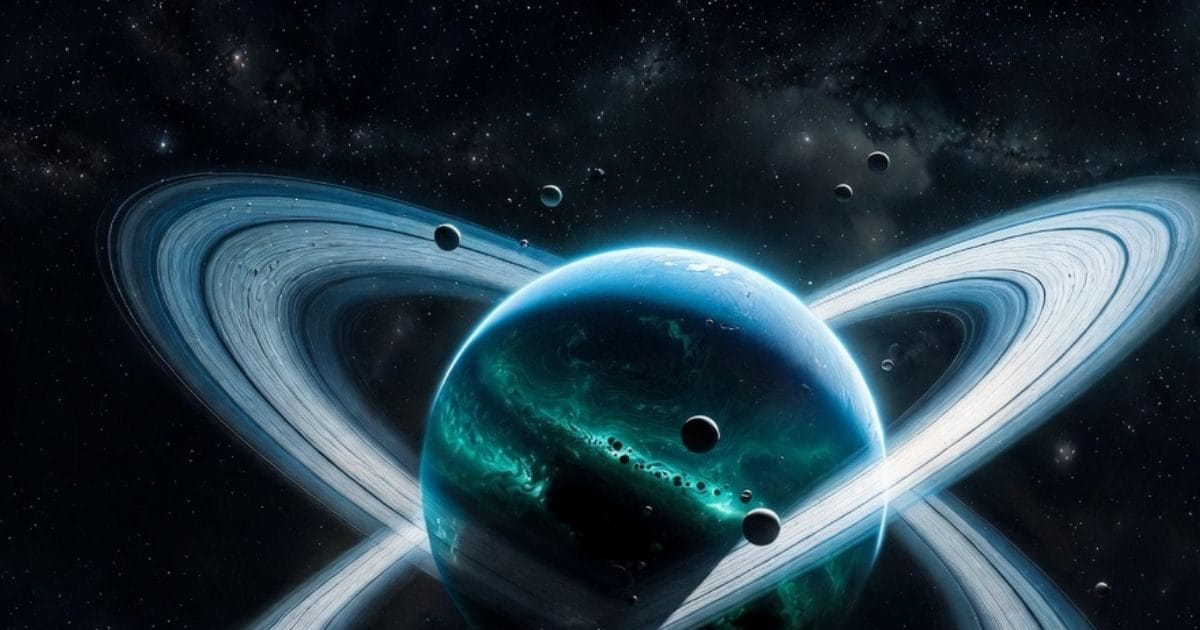
Space is still full of mysteries. Uranus, the seventh planet of our solar system, is the most vivid example of this. It was discovered on this day in 1977, on March 10. A historic discovery of 13 faint rings around this blue-green planet was made. A strange world where one year is equal to 84 years of the earth and where there is continuous day for 21 years and dreadful night for 21 years.

On this day in 1977, Uranus was discovered.
New Delhi: Uranus, the seventh planet of the solar system, remains the center of attraction for its unique inclination and mysterious structure. It is tilted on its axis by approximately 98 degrees. It appears to be rolling around the Sun like a ball. The day of March 10, 1977 is considered very important in the history of science. On this day, scientists discovered the faint rings around Uranus for the first time.
According to the American space agency NASA, Uranus is the third largest planet in the solar system. Its equatorial diameter is approximately 51,118 kilometers, which is about four times wider than the Earth. This planet is located at an average distance of 2.9 billion kilometers from the Sun. Sunlight takes approximately 2 hours 40 minutes to reach here. A day on Uranus is approximately 17 hours long, while it takes 84 Earth years to complete one orbit around the Sun.
The rings of Uranus were discovered in 1977.
cause of tilt on axis
The inclination of this planet is so unusual that even the seasons here are very strange. One pole of Uranus receives continuous sunlight for about 21 years, while the other pole remains immersed in deep darkness for the same period. Uranus and Venus are planets that rotate in the opposite direction to most planets. A total of 13 major faint rings are found around Uranus. These rings are extremely thin and dark brown in color, some of which are surrounded by layers of fine dust. Of these, the two outer rings appear red and blue, which makes the structure of this planet even more mysterious.
blue-green planet
Apart from this, Uranus has 28 known moons. These moons are named after characters in the works of famous authors William Shakespeare and Alexander Pope. Moons like Titania, Oberon and Miranda are prominent among them. According to scientists, these moons are mainly made of water ice and rocks. Uranus is also called the Ice Giant planet. Most of it is made up of hot liquid forms of water, methane and ammonia. Due to the presence of methane gas this planet appears blue-green. The temperature here can drop to -224 degrees Celsius, making it one of the coldest planets in the solar system. The wind speed here can reach up to 900 kilometers per hour.
This planet is made of gas and liquid
The surface of Uranus is not solid, but is composed mainly of rotating gases and liquids. For this reason, it is considered almost impossible for any spacecraft to land or fly safely here. In 1986, NASA’s Voyager-2 spacecraft flew by Uranus and transmitted important information related to the planet’s rings, moons and weather to Earth. In recent years, scientists have also observed rapid changes in the clouds of Uranus. The magnetic field of this planet is also very unique. It is tilted about 60 degrees from the planet’s rotation axis and is also located slightly away from the planet’s center. This is the reason why the aurora light formed here is not formed directly at the poles.
About the Author

Deep Raj Deepak joins News18 in 2022. Currently working on home page. Interest in politics and current affairs, social, science, research and viral news. Also interested in news from cricket and entertainment world. Banaras Hindu…read more