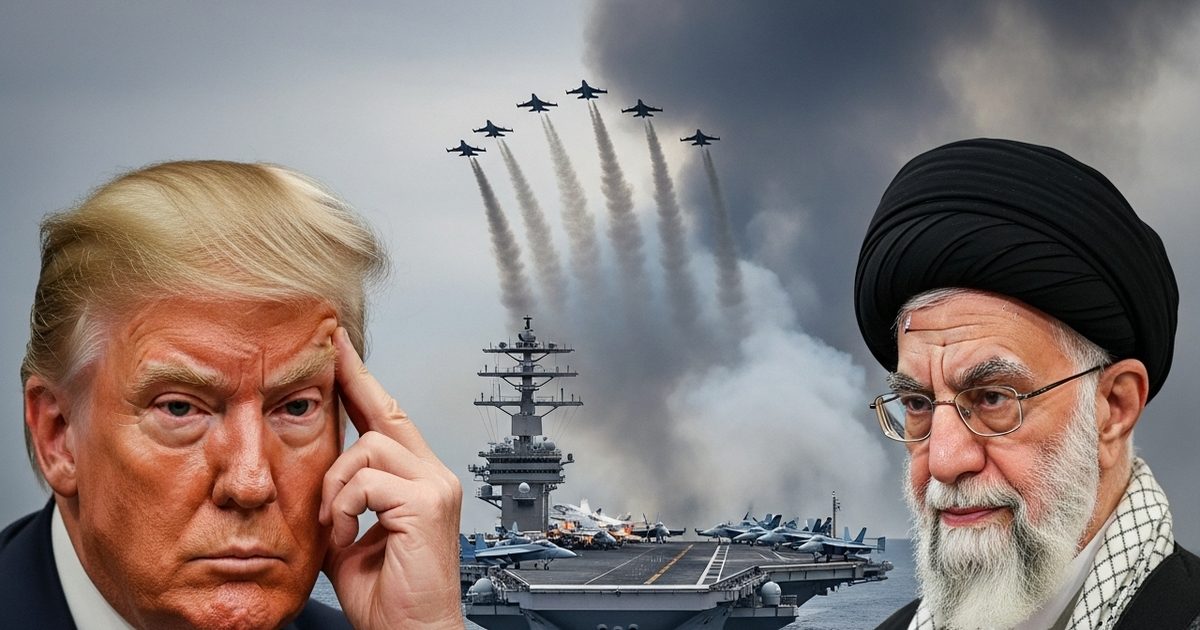
America and Israel together have attacked many cities of Iran. In response, Iran has also retaliated with missiles at many places from Israel to the United Arab Emirates. However, experts are warning that an attack on Iran would be much more complex than an operation in Venezuela. This struggle may drag on for a long time.
Iran’s leadership possesses extensive military capabilities and a network of regional proxy forces that, should it jump into this fight, would not only expand but could also prolong it.
In a report published in the New York Times, experts had warned America against an attack against Iran. According to this report, Ali Waez of the organization International Crisis Group said, “America’s fight in the case of Iran will not be small, it is not something that Iran can be easily controlled.” This fight will increase the danger in the world. The threat to the lives of American citizens will increase. However, these attacks may give advantage to Trump in the year of midterm elections.
This is not an easy operation like Venezuela
Before the US attack in January, Venezuela’s skies were relatively unsafe. According to regional experts, Iran has one of the largest and most diverse missile stockpiles in the Middle East. Its arsenal includes drones and anti-ship weapons, although the current number of Iran’s missile stockpile remains unclear after a 12-day war with Israel in June.
How far can Iran’s missiles hit?
Iran’s medium-range ballistic missiles are capable of a range of more than 1,200 miles, including US bases in western Turkey and the wider Middle East region, including Israel and the Gulf countries.
Iran first tested a sea-based air-defense missile with a range of more than 93 miles during military exercises in the Strait of Hormuz last week.
What will be Iran’s strategy?
The New York Times report quoted expert Sanam Vakil as saying that Tehran’s strategy will be to rapidly increase instability on many fronts so that this war spreads, due to which America and allied countries will also be in equal trouble.
In the Gulf countries, where many US military bases are located, there are concerns that any US military attack could lead to retaliatory action against them. This is the concern of America’s allies in the Gulf countries. Who were continuously insisting that this war could be avoided somehow.
The stance of Saudi Arabia and UAE
Saudi Arabia and the United Arab Emirates have already said that they will not allow America to use their airspace for attacks. However, their fear has turned out to be true that Iran’s missiles will hit them too.
Not easy for Israel
Major cities of Israel may be affected by Iran’s retaliatory attack. During the war that began in June, the Israeli army shot down most of Iran’s missiles using interceptor missiles. But it also caused loss to Israel. Intelligence officials say that after more than two years of continuously dealing with attacks by Hamas in Gaza and Hezbollah in Lebanon, Israel may have reduced the number of interceptor missiles.
Iran will activate proxy forces
Iran operates a “resistance axis” in the Middle East using proxy forces, including the Houthis in Yemen and Hezbollah in Lebanon. It has created and armed these groups to increase its influence in the region and challenge its opponents. Although many proxy groups have been severely weakened, they may still retaliate against US forces and allies, creating multiple fronts and allowing the conflict to spread beyond Iran’s borders.
At least one pro-Iranian group in Iraq has pledged support for Tehran in the event of a US attack. Its leaders have warned that they could order a “martyrdom campaign” as part of a wider conflict. Experts also say Houthi rebels could resume targeting commercial ships in the Red Sea as they did during the war with Israel in support of Hamas in late 2023.
Why is it not easy to remove the government in Iran?
The Iranian government is a theocracy in which the supreme leader is the main authority. Its real strength is the Islamic Revolutionary Guards Corps, a fearsome and powerful branch of the armed forces, estimated to number around 150,000, that protect and advance the regime’s authoritarian agenda.
Removing the government in Iran is not as easy as removing the supreme leader. Real power in Iran is driven by ideology, which is supported by political fundamentalists. It is further strengthened by a complex power structure that has been in place for nearly half a century.
Iran has previously threatened to close the Strait of Hormuz, blocking one of the world’s most important energy transportation routes. About one-fifth of the world’s oil and liquefied natural gas is transported through this strait.