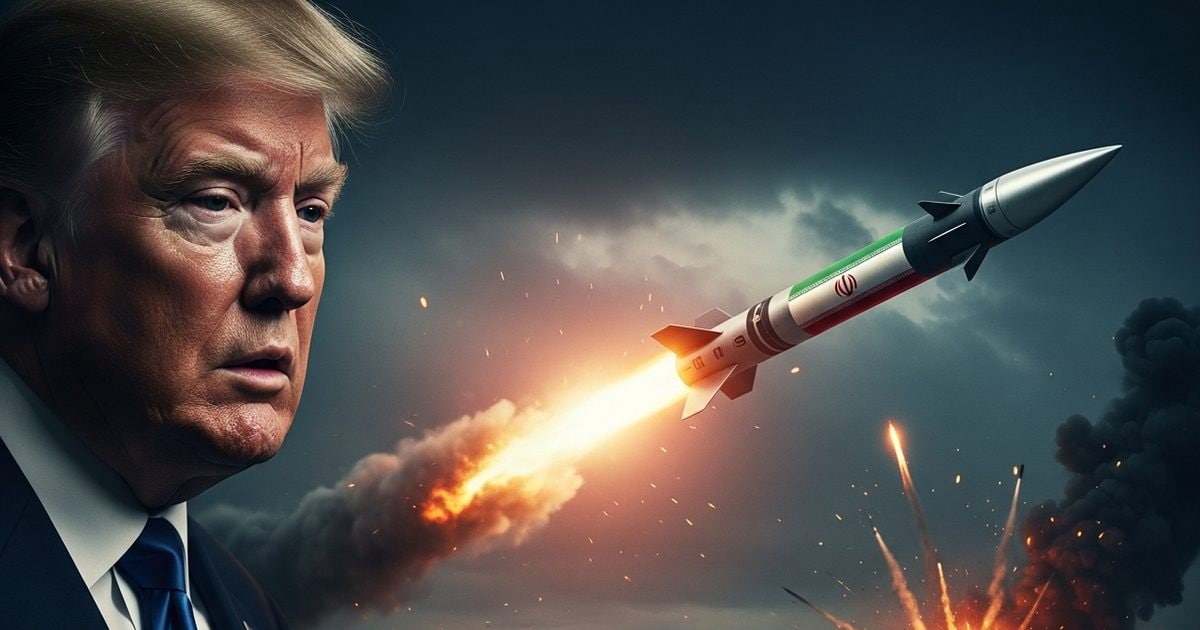
The war started by America against Iran has reached its 13th day. In this war, America is facing resistance and losses from Iran against expectations. According to the report, Iran has caused considerable destruction on 17 of its bases in the Gulf countries. Amidst this situation of war, Chinese Professor Jiang Xiuqing is also becoming famous. He has predicted that America will lose this war. In fact, the way his two predictions made on the basis of analysis two years ago turned out to be true, this third prediction is becoming quite popular. It is beginning to be analyzed as to why he has said this.
Chinese professor Jiang Xiuqing is a scholar of Yale University. This report related to him has been published by Palestine Chronicle. Which is being read extensively. Jiang had made this prediction two years ago through his predictive history platform. Here he analyzes the behavior of empires.
Those three prophecies, two of which turned out to be true
Jiang had made three predictions in 2024 – Donald Trump will return to the US presidency – this happened. The second prediction was – there will be an outbreak of war with Iran – this is also happening. The third prediction was that there is a possibility of America’s defeat in this war. The first two predictions have come true, which is why Jiang’s third prediction is now getting more attention. Jiang’s argument focuses not on the size of the military arsenal, but on the endurance and flexibility of the parties involved. Jiang is also known for his YouTube channel Predictive History. He has the nickname of “Nostradamus of China”.
Jiang says the current conflict is not a conventional war that will end quickly, but rather one that will escalate slowly and cause significant damage. According to him, Iran’s strategy is to last longer and cause damage to the enemy gradually.
Vietnam war where America lost
He presents the Vietnam War as a historical example for this. America started this war in the early 60’s. This fight continued for about 15 years. America lost that war not because of lack of military capability, but because the war had turned into a long-term conflict in which the Vietnamese leadership had completely exhausted American political and economic resources. Then America had unnecessarily started a war against Vietnam just to prevent it from becoming a communist country. Ultimately America could not stop him from doing so.
Iran has more capabilities than Vietnam
Well, let us tell you that today Iran has such capabilities which Vietnam never had. These include state-of-the-art ballistic missile stockpiles, advanced drone programs and electronic warfare capabilities. Additionally, Iran has formed regional alliances and proxies. It has a major strategic influence through the Strait of Hormuz, through which about a third of the global oil supply passes. When he closed this water route during the war, more than half the world started crying.
Taken together, these capabilities enhance not only Iran’s ability to defend itself but also its ability to impose large-scale, sustained warfare on its adversaries – Iran could perhaps sustain a more forceful and complex war than the guerrilla war experienced in Vietnam. The key issues here are time, financial cost, and internal pressures that will determine whether or not military superiority will last.
Why is a long war dangerous for the world?
A prolonged war in the Gulf region would be dangerous for the world, because its importance goes far beyond maritime transport, transportation of goods and energy production; It is also capable of keeping a direct hand on the pulse of global economic systems and these days the whole world is realizing this.
A long war would put double pressure on Washington. Disruptions in energy flows and trade routes could weaken global markets. At the same time, a long war can also increase the financial and military burden. The biggest problem is that if the war continues for a long time, then all the countries of the Gulf will face the danger of destruction, these countries are mostly America’s allies, for whose protection America has been claiming responsibility. Due to disruption in supply chains and sea routes, the economic stability, social unity and security of these Gulf countries and also of other countries of the world will collapse.
What have the Gulf countries started believing?
This tension is already visible in the political discussions within the Gulf countries. Prominent regional figures, including former Qatari Prime Minister Hamad bin Jassim, Saudi Arabia’s Prince Turki al-Faisal and Emirati businessman Khalaf Al Habtoor, have suggested that the war is not fundamentally a conflict between the Gulf states, but a conflict driven by the interests of Washington and Tel Aviv. Such statements show the growing trend in the political thinking of the Gulf countries. This means that they are getting into trouble because of Israel’s ambitions.
blockage of the strait of homurz
Apart from the military aspect, food security can become one of the most sensitive issues. Gulf countries import about 90 percent of their food supplies through sea routes passing through the Strait of Hormuz. Although officials insist that strategic reserves can meet four to six months of consumption, a prolonged disruption would create severe economic and social pressures.
In such circumstances, this region may become an additional arena of economic and political tension. Besides, America’s domestic political environment will also be equally affected by this. Public opposition to foreign wars has increased continuously in the last two decades.
There will be problems at home for Trump
A prolonged conflict could prove fatal for the political base due to which Trump returned to power after winning re-election. Domestic opposition may increase against him, which will increase pressure on the administration and Congress.
Opinion polls show that American citizens are becoming increasingly reluctant to support new military interventions abroad. Congress voting also revealed deep divisions, with the bill passing by a narrow margin of 47 votes to 53.
Israel does not know how to fight long wars
Historically, Israeli strategy has been based on quick victories, aimed at reducing long-term economic disruption and social tension. A long and exhausting war will challenge this model. If this has the effect of shattering the image of Israel as a strong country and making it appear weak, then it will have a severe economic burden and social impact on America.
Reuters, quoting reliable sources, reported that in the first week of the war, direct economic losses due to disruption of industrial activities, displacement from northern areas and a sharp decline in air traffic exceeded two billion dollars.
This is the basic idea of Jiang Xiuqin’s analysis. In continuing wars there is often no dramatic collapse on the battlefield. Instead, they reshape results through gradual exhaustion. If Jiang’s prediction of an American defeat comes true, it would probably not be like the sudden collapse of an army on the battlefield. Instead, it will manifest itself in a gradual erosion of political prestige and an inability to implement strategic objectives.