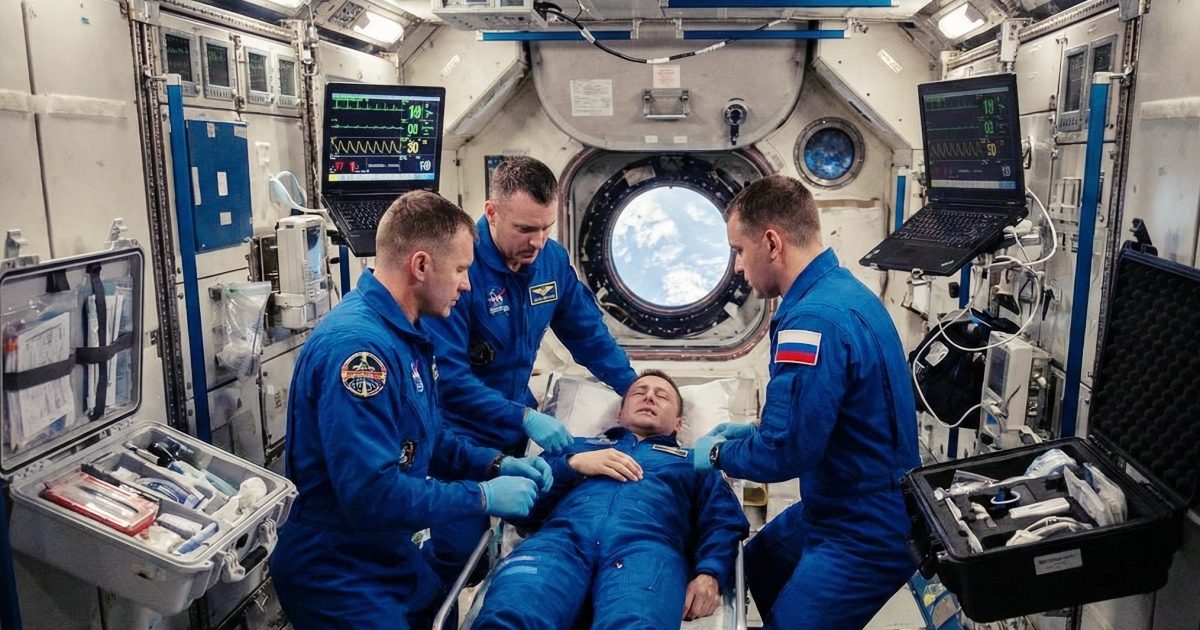
What is the full story of this sudden medical emergency in space?
What is space sickness?
Most astronauts face ‘space adaptation syndrome’ for the first few days before going to space. Vomiting, dizziness and feeling of heaviness are common in this. Scientists believe that due to lack of gravity the balance inside the ear gets disturbed. However, the body becomes accustomed to it in a few days. But in the case of Crew-11, the problem is said to be much more serious than this.

There is no hospital on the space station. There is definitely a small medical care unit. (Photo: NASA)
Is there a secret hospital of doctors in space too?
There is no big hospital or operation theater on the ISS. There is only a small ‘medical care system’. It is called Crew Health Care System (CHeCS). It contains life saving medicines and some portable equipment. There is also a small portable ultrasound machine. With its help the internal parts of the body can be examined. Apart from this there is also Health Maintenance System (HMS). Defibrillator and oxygen facilities are also provided in it. If any major surgery is required, there is currently no such facility on the space station. In such a situation, the only safe option is to bring the astronaut back to Earth immediately.
What medicines do astronauts carry with them?
Astronauts carry a special medical kit with them. This includes medicines ranging from everyday ailments to severe pain. Below is a list of medications that are normally available on the space station:
Painkillers: Medicines like aspirin, ibuprofen and acetaminophen are for headache and body pain.
motion sickness: Special patches and medicines are given to prevent dizziness or vomiting in space.
Sleep Medicines: There is no fixed time for sleeping in space, hence medicines like ‘melatonin’ are kept for sleep.
Antibiotics: Broad-spectrum antibiotics are available to prevent any kind of infection.
Allergy medicines: Anti-histamine medicines are kept with us for allergies caused by dust or other reasons.
First aid: This includes bandages, ointments, eye-drops and wound-cleansing liquids.
How big a challenge is it for doctors to treat in zero gravity?
Treatment in space is many times more difficult than on Earth. The biggest problem in zero gravity comes with liquids. If an injection is to be given to an astronaut, the drops of medicine start floating in the air. Apart from this, air bubbles in the syringe are also a big danger. The blood flow inside the body also increases upwards i.e. towards the face. Due to this the immunity of the body also becomes weak. The wound healing process also slows down in space. In such a situation, there is a fear of any minor disease turning into a major infection. That is why NASA monitors the heartbeat and health data of its astronauts every second.
Who are those four astronauts who are in trouble right now?
The Crew-11 mission was launched on August 1, 2025, by SpaceX’s Dragon spacecraft. Four experienced members are included in this mission. Their information can be seen in the table given below:
| Astronaut’s name | space agency | Country |
|---|---|---|
| gina cardman | NASA | America |
| Michael Finke | NASA | America |
| kimiya yui | JAXA | Japan |
| Oleg Platonov | Roscosmos | Russia |

Members of Crew-11 currently present on the ISS.
Their mission was to end in February 2026. But due to medical issue, his return can happen at any time. NASA Administrator Jared Isaacman has said that the safety of the team is his top priority.
Why did such an emergency occur in space only after 25 years?
In the last 25 years, NASA has kept its health protocols very strict. Astronauts have to remain in quarantine for several months before going into space. This eliminates the risk of any kind of virus going into space. Besides, basic medical training is also given to every astronaut. So that they can treat minor wounds or diseases themselves. But there are some diseases which are difficult to identify in advance. The current incident is also not related to any injury or mission. This is an internal medical problem that can happen to anyone. This is the reason why it is being considered a rare case.