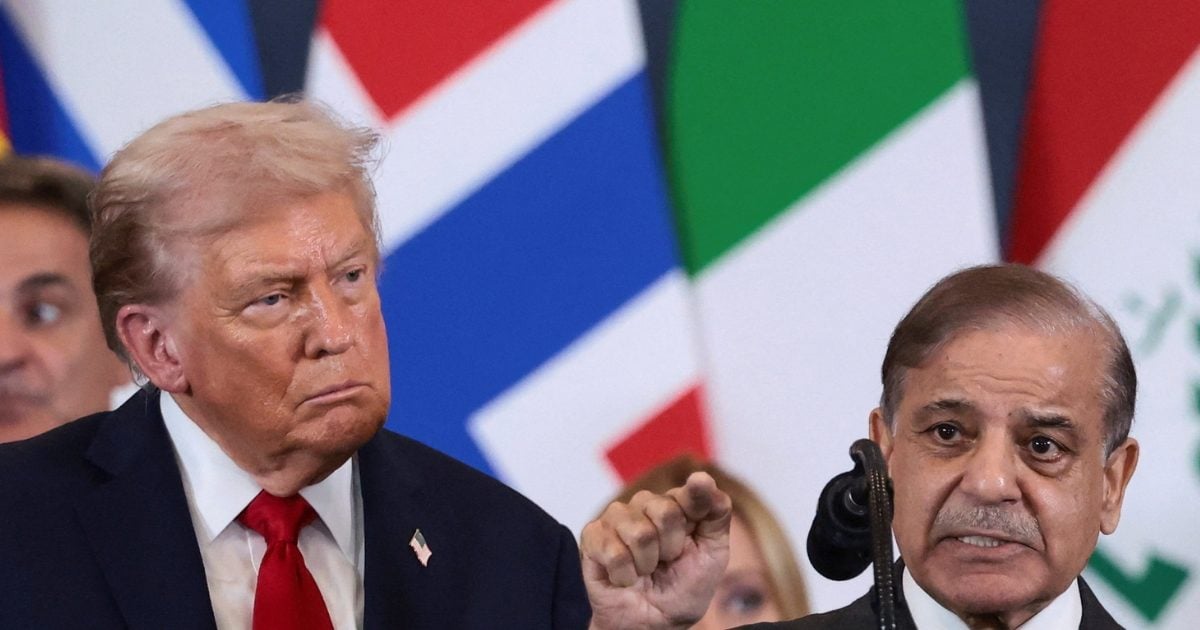
Pakistan News: After receiving the title of Field Marshal, Pakistan Army Chief Asim Munir went on an American tour. There he met President Donald Trump. Also tasted biryani and other dishes thoroughly. Now the time has come for Pakistan to pay the price. Activism on international forums is not a new thing for Pakistan, but this time one of its decisions has raised questions from domestic politics to global economic circles. Pakistan’s announcement to join the ‘Board of Peace’ initially launched for Gaza by US President Donald Trump has come at a time when its economy is under severe pressure and the country is dependent on the assistance of the International Monetary Fund (IMF). At the same time, IMF has approved a new installment of 1.2 billion dollars (₹ 11032 crore – in Indian currency) for Pakistan. This further intensified the debate whether these funds were indirectly going into some expensive geo-political project. Especially in Trump’s Board of Peace.
Pakistan’s Shahbaz Sharif government has not yet made it clear whether it will take any major financial commitment under the Board of Peace or not, but an important provision related to this initiative of Trump (permanent membership on giving $1 billion in the first year) has become a cause of concern within the country. The question is whether Pakistan, which is facing economic crisis, can afford such expenditure and if so, will it be possible with IMF assistance. The ‘Board of Peace’ is an international platform introduced by President Trump at the World Economic Forum (WEF), Davos, whose purpose is said to be to establish peace, reconstruction and strengthen governance in conflict-torn areas. Its priority is currently said to be focused on conflict areas like Gaza. Trump is the chairman of this board and has the final authority on everything from membership to guidelines.
Who is in the Board of Peace?
Prominent personalities included in the Board of Peace include former British Prime Minister Tony Blair, US Secretary of State Marco Rubio, Trump’s son-in-law and adviser Jared Kushner and his special envoy Steve Witkoff. So far, more than two dozen countries have agreed to participate in it, which includes countries like Israel, Saudi Arabia, United Arab Emirates, Turkey, Egypt, Morocco, Indonesia and Pakistan. The thing to note is that apart from America, no permanent member of the United Nations Security Council has participated in it. Countries like Canada, France and Britain have maintained distance from this forum, while some countries have expressed uneasiness saying that this initiative could weaken the multilateral peacekeeping system of the United Nations.
1 billion dollar condition and Pakistani concern
There is an important provision in the draft charter of this board – member countries will be appointed for a period of three years, but if a country contributes $1 billion in cash in the first year, its membership can be almost permanent. This amount is said to be earmarked for the reconstruction of conflict areas, especially in the context of Gaza. This provision has become the main center of debate within Pakistan. Although Islamabad has not formally said that it will give this amount, the existence of such a condition in the times of economic crisis is raising many questions. Critics say that committing billions of dollars to an international forum could create discontent among ordinary citizens when the government is struggling to raise resources for domestic spending, subsidies, education and health services.
IMF aid and Pakistan’s fragile economy
The IMF has recently approved a new tranche of $1.2 billion for Pakistan, out of which $1 billion is under the Extended Fund Facility (EFF) and $200 million is under the Resilience and Sustainability Facility (RSF). This is part of a total package of $3.3 billion, which has been given with the aim of stabilizing the country’s wavering economy.
Pakistan currently owes the IMF more than $7.35 billion and has taken assistance from the IMF about two dozen times since the 1950s. It was very close to defaulting in the year 2023 and last year it got a bailout package of $7 billion. In March it also received a new climate resilience loan of $1.3 billion.
The country is in economic ICU
Despite all these relief packages, Pakistan’s economic situation still remains worrying. By September 2025, its external debt had reached $134 billion, while by June 2025, the total public debt would reach approximately $286.8 billion, which is 13 percent more than last year. The debt-to-GDP ratio remains around 70 percent. Islamabad has also sought debt restructuring from friendly countries, including a request to the UAE to reduce the interest rate and extend the tenure on the $2.5 billion facility. It is clear from this how much pressure the financial situation of the country is under.