Iran Destroy USA THAAD: The Iran war is entering a more dangerous phase with each passing day. While the whole world is hopeful that this war will end as soon as possible, on the other hand, the pictures continuously coming in are showing the terrible situation of this conflict. America killed Iran’s Supreme Leader Ayatollah Ali Khamenei on the very first day of the attack. Not only Iran but the entire world was stunned by this. Tehran also retaliated and targeted many American military and airbases in the Arab world. Khamenei’s army, on its very first day, gave America a wound that it had not received in decades. Khamenei’s army was the first to destroy the THAAD air defense system that the USA was proud of. American radar systems located in UAE, Jordan and Qatar have been targeted. The scene of devastation caused by the Iranian attack in these three countries can be clearly seen in the satellite images. Now I understand the meaning of the US government’s statement in which it was said that the Iran war will be prolonged.
Amidst the ongoing military conflict between Iran and America-Israel, American military bases located in the Gulf region have also come under direct target. New satellite images recently surfaced indicate that Iran has targeted military bases in Jordan and the United Arab Emirates, where important radars of the American missile interceptor system were deployed. The aim of these attacks is said to be to weaken the air defense network present in the area. Analysis of satellite imagery shows that the radar system of a US THAAD missile battery deployed at Salti Air Base in Jordan was targeted during the initial attacks. According to CNN’s report, the THAAD missile battery was probably destroyed. The attack came at a time when Tehran began targeting US military installations across the region in response to the massive air campaign launched by the US and Israel against Iran.
Heavy damage to radar at Jordanian airbase
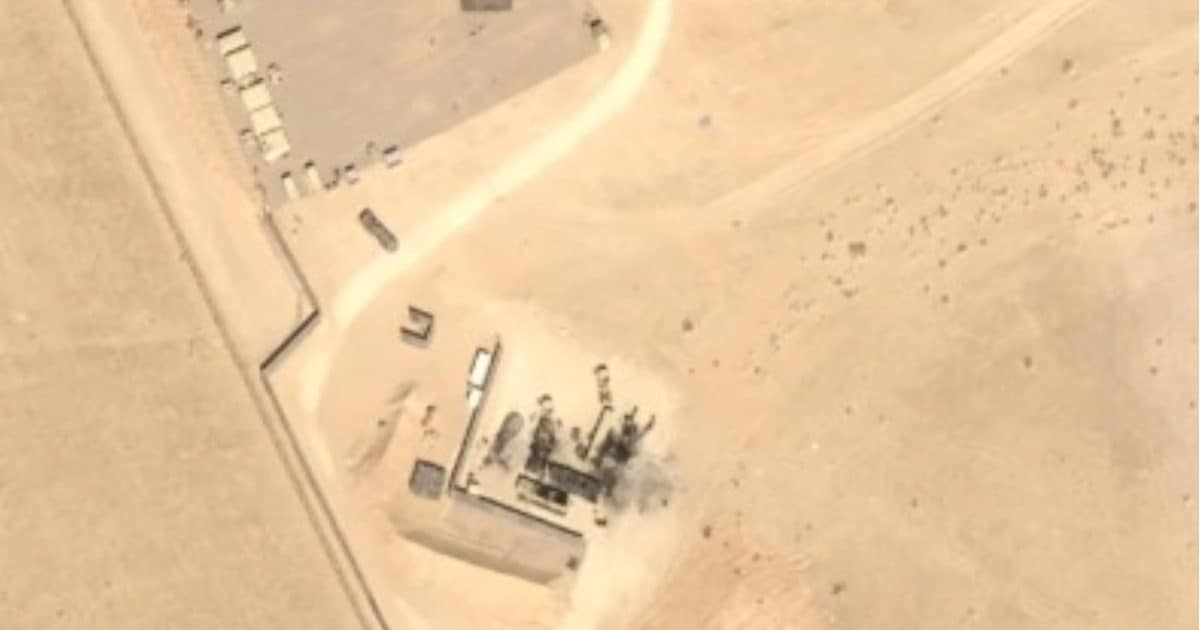
Satellite images taken on Monday show two large craters about 13 feet wide in the sand near Salti Air Base in Jordan. According to experts, this indicates that more than one missile may have been used to accurately target the radar system. The radar that was targeted is the AN/TPY-2 transportable radar of the THAAD missile defense system, which is manufactured by American defense company Raytheon. This radar is equipped with extremely advanced technology and is used to detect incoming ballistic missiles and drones from a great distance. This radar plays a central role for a THAAD battery, because it is through it that interceptor missiles get target information. According to the 2025 budget documents of the US Missile Defense Agency, the cost of this radar is around $500 million. According to the report, this radar system is installed on five large trailers, each of which is approximately 40 feet long. Satellite images indicate that all these trailers have been seriously damaged or completely destroyed.
THAAD is one of the world’s advanced air defense systems. (File photo/Reuters)
American base was active since February
According to the information, this THAAD battery was deployed at this Jordanian air base since mid-February. This base is located about 500 miles from Iran and has long been a major center of regional military activities for the US. More than 50 fighter planes were seen at this air base in satellite photos taken before the conflict started. Apart from this, there were also drones, transport aircraft and many military shelters present, in which more aircraft could have been hidden. For this reason, this base is considered very important for American military operations in the area.
Attacks on radar sites in UAE also
Analysis of satellite images has also revealed that similar attacks have taken place on two different military installations in the United Arab Emirates. According to reports, many buildings have been damaged at military bases located near Ruwais and Sader. At least three buildings in the military complex in Ruwais showed signs of damage, while four structures in Sader showed signs of attack. Buildings damaged included vehicle sheds used to house the THAAD battery’s radar systems. However, it is not yet clear whether the radar systems present there were completely destroyed in these attacks or not. Due to non-availability of high resolution satellite images, it has not been decided whether radar systems were present at these targets at the time of the attack or not.
Iran has destroyed the US-made early-warning radar system located in Qatar. (Photo credit: Planet Labs PBC/Middlebury Institute)
Attack on American or UAE radar system?
It is also not clear whether the US Army’s THAAD batteries were deployed in the UAE targets that were targeted or whether they were batteries sold by the US to the UAE. However, a review of satellite images has confirmed that equipment associated with the THAAD system has been observed at these two locations since 2016 and 2018. Experts believe that if there is serious damage to these radars, it may affect the capability of the air defense network present in the area.
What is THAAD missile defense system and what is its main purpose?
Terminal High Altitude Area Defense (THAAD) is an important part of the US ballistic missile defense system. Its main objective is to destroy enemy ballistic missiles in their final stage. This system uses “hit-to-kill” technology, in which the interceptor missile destroys the target by directly hitting it. THAAD can intercept targets at a distance of about 150 to 200 kilometers. It provides larger area protection than the Patriot Air and Missile Defense System and works in conjunction with other missile defense systems.
What does a THAAD system consist of and a battery?
About 90 soldiers are deployed in a battery of THAAD who handle its operation and maintenance. It has 6 truck-mounted launchers and each launcher has 8 interceptor missiles, that is, a total of 48 interceptors are present. Apart from this, it has a state-of-the-art AN/TPY-2 radar system which tracks enemy missiles. Along with this, there is also a tactical fire control and communication system, which coordinates the entire operation.
What types of missile threats is THAAD capable of stopping?
THAAD is designed to intercept short, medium and limited intermediate range ballistic missiles. It can intercept short range missiles of up to 1,000 kilometers, medium range missiles of 1,000 to 3,000 kilometers and intermediate range missiles of 3,000 to 5,000 kilometers. It destroys the missiles in their final stage i.e. terminal phase. The special thing is that THAAD has the ability to intercept both inside and outside the atmosphere.
Who developed the THAAD system and who is responsible for its operation?
The THAAD system has been developed by the American company Lockheed Martin, whose headquarters is located in Bethesda, Maryland. It is manufactured in Troy city of Alabama. The responsibility for the development and technical maintenance of this system lies with the Missile Defense Agency (MDA). The US Army handles its operation and general maintenance. MDA also ensures that all THAAD batteries function properly and that soldiers receive adequate training.
How many THAAD batteries does the US Army have and where are they deployed?
Currently the US Army has a total of eight THAAD batteries. The first THAAD battery was activated in May 2008 at Fort Bliss, Texas. According to reports, three batteries are deployed at Fort Bliss and two batteries are located at Fort Cavazos, Texas. Apart from this, one battery is deployed in South Korea and one in Guam. However, the possible deployment location of the eighth battery has not been made public.
big loss
According to NR Janzen Jones, weapons expert and director of Armament Research Services (ARES), the AN/TPY-2 radar is a very important component of the THAAD system. According to him, this radar not only helps in launching interceptor missiles but also provides a coordinated picture of air defense in the entire area. He said that it is not easy to replace this type of radar quickly. If a radar is destroyed, a new radar has to be brought from another area and deployed in its place, which takes a lot of time and resources. According to Jensen Jones, the THAAD system is capable of protecting a large area, but to make it effective it is used in conjunction with other air defense systems such as Patriot. This is done so that better protection can be provided from different types of threats such as ballistic missiles, cruise missiles and drones.
Tehran Times, citing Chinese satellite images in its X post, has said that the American base has been destroyed in the attack on Tehran. (Photo credit: Courtesy: @TehranTimes79’s X account)
Communication and intelligence equipment also targeted
Even before this, reports had come out that Iran had carried out such attacks on American military bases located in the Gulf region whose aim was to damage communications, radar and intelligence equipment. It is believed that Iran’s strategy is to weaken the American military network and isolate them at the regional level. Analysis of satellite images also revealed that an early warning radar system in the Umm Dahl area of Qatar has also been damaged. This radar is said to be based on American technology and is used to detect possible missile attacks in advance.