Last Updated:
Indian Navy: The foundation of the global system has been shaken due to the Iran war. The war waged against Iran under the leadership of America and Israel has had a serious impact on the energy sector. Especially due to the impact of movement of ships through the Strait of Hormuz, the supply chain of petroleum products as well as gas has been significantly affected.
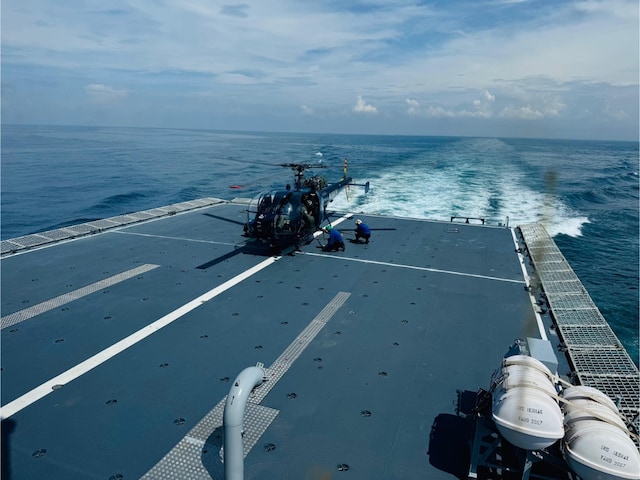

These days the Indian Navy is taking part in anti-submarine warfare exercises at America’s Guam airbase. (Photo: Courtesy: Indian Navy’s Facebook account)
Indian Navy: The foundation of the global system has been shaken by the Iran war. The situation has become serious especially due to disruption in the energy supply chain. After the attack on Iran by America and Israel, the situation is continuously worsening. Not only Asia, many countries of the world are being affected due to disruption in ship transportation related activities in the Strait of Hormuz. Tension has increased further since the American submarine destroyed the Iranian warship IRIS Den in the international waters of the Indian Ocean near the Sri Lankan coast. The Indian Navy team with the warship has reached the American Guam airbase, about 7000 kilometers away from where America destroyed the Iranian warship. Actually, multinational anti-submarine warfare drill is going on at Guam base. Indian Navy is also taking part in this, so that it can protect itself from attacks by submarines.
According to the information, armies of many friendly countries including the Indian Navy are participating in the multinational military exercise Exercise Sea Dragon 2026 being organized in March at Anderson Air Force Base in Guam. This US-led exercise is being conducted mainly with the aim of strengthening anti-submarine warfare capabilities and increasing cooperation in the Indo-Pacific region. Apart from the Indian Navy, teams from the US Navy, Royal Australian Air Force (RAAF), Japan Maritime Self-Defense Force and Royal New Zealand Air Force are also included in this multinational exercise. The participating countries aim to strengthen maritime security, enhance mutual coordination and improve their collective ability to conduct anti-submarine operations in the region.
Guam airbase is approximately 7000 kilometers away from the place where the American submarine destroyed the Iranian warship IRIS Dena. (File photo/Reuters)
ultra modern system
According to the Australian Defense Ministry, the Royal Australian Air Force has sent about 50 aviators to Guam with its state-of-the-art P-8A Poseidon maritime patrol aircraft to take part in this exercise. This multirole mission aircraft is known for missions like long-range maritime surveillance, intelligence gathering and submarine detection. In this exercise which will last for about two weeks, the air crews of the participating countries will take part in various complex training missions. During these operations, they will be trained to detect, pursue and retaliate against submarine targets in challenging conditions. The main objective of the training is to improve mission speed, accuracy and coordination between multinational teams. The format of the exercise has also been kept competitive, so that the Air Force and Navy teams of the participating countries can further improve their strategies. This will also strengthen interoperability, i.e. the ability to work jointly, between the armies of different countries.
operational capability
Detachment Commander and Squadron Leader Bryce Martin of Exercise Sea Dragon 2026 said that this exercise is an important opportunity for the Australian Air Force to strengthen its own operational capabilities and deepen relationships with regional partners. He said that the vast maritime training area spread near Guam gives pilots an opportunity to practice in complex conditions and develop better coordination with allied countries. He said, ‘Exercise Sea Dragon 26 is an excellent opportunity to hone our skills and strengthen cooperation with international partners. The vast maritime area available here helps us practice complex operations and further improve coordination with allied countries. According to experts, the role of submarines in modern naval strategy is continuously increasing. In such a situation, anti-submarine maneuvers have become very important for any navy. Multinational exercises like Sea Dragon not only improve technical capacity, but also enhance trust and cooperation among countries to address common threats to maritime security.
P-8A Poseidon
The participation of Australia’s P-8A Poseidon aircraft is also considered important in this exercise. Australia currently has 13 such state-of-the-art maritime patrol aircraft, which are used in long-range surveillance, intelligence gathering and maritime security operations. These aircraft are equipped with advanced sensors and communication systems, capable of detecting submarines and surface ships in vast maritime areas. According to defense officials, the aircraft and personnel deployed in Guam will work closely with the armies of other countries during the exercise. This will further strengthen operational coordination and strategic understanding between the participating countries. Sea Dragon 2026 is being considered an important part of the collective security strategy of allied countries amidst the increasing strategic challenges in the Indo-Pacific region. Such joint military exercises play an important role in ensuring the security and stability of the major sea lanes of the region.
About the Author

Received primary and higher education from Bihar, Uttar Pradesh and Delhi. After graduation from Jhansi, he did PG Diploma in Journalism from Delhi University. Started professional career from Hindustan Times Group…read more