Is heat the biggest enemy for hypersonic flights?
- Hypersonic vehicles are those which travel at a speed 5 times more than the speed of sound i.e. about 6,115 kilometers per hour. When an object moves so fast, air molecules collide with it and create tremendous heat and pressure. In this condition, leave aside normal iron or steel, even good materials melt like wax.
- Till now scientists have been using carbon composites for this, but they also have many shortcomings. They gradually start oxidising in the air and have to be repaired again and again. To solve this problem, scientists have started work on ‘Ultra-High-Temperature Ceramic’ (UHTC), which can be used again and again without melting.
How was this dangerous test done in the plasma wind tunnel?
- Researchers at Italy’s University of Naples Federico II prepared two different versions of ceramic for this test. The base material of both was the same, but in one Niobium Carbide was added and in the other Vanadium Carbide was added.
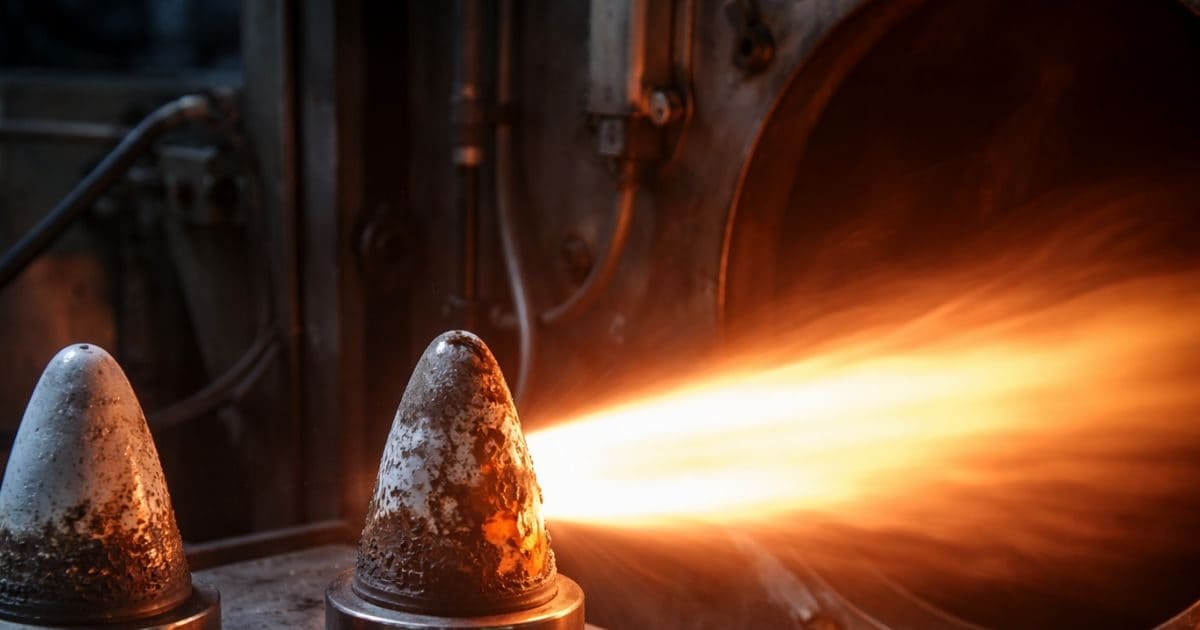
- These samples were kept in a tunnel named ‘Small Planetary Entry Simulator’ (SPES). This tunnel uses plasma heated by electricity to generate the same heat that a spacecraft has to endure while returning to Earth from space.
- First they were kept in Mach 6 speed conditions, where the temperature was 1,800K. After this it was increased to 2,700K, so that their real strength could be known.
How does this advanced ceramic protect itself from burning?
During this research, scientists observed a very interesting thing. When this material came in contact with extreme heat, the silicon carbide present inside it reacted with oxygen. This created a thin layer of glass-like ‘silica’ on top of the material. This layer acted like a shield and protected the inner part from burning.
However, when the temperature went above 2,200K, this protective shield started becoming a little unstable. Bubbles started forming on the surface and some parts started falling off, but still the main structure remained in place. The biggest feature of this material is that the damage is limited to the upper surface only.
Is Zirconium Oxide the shield of the future?
- When examined under a microscope after the test, it was found that the outermost protective layer was occupied by zirconium oxide. The thermal conductivity of this oxide is very low, which means that it does not allow heat to pass inwards.
- Apart from this, elements like niobium and vanadium changed the method of oxidation, making this layer more durable. Researchers say that this material can withstand many high-heat cycles.
- This discovery is very important for those spacecraft which have to go to space and come back again and again, because it will save both maintenance cost and time.
Why is this discovery important in the hypersonic arms race?
In today’s era, hypersonic missiles have become the new measure of global military power. America, China and Russia are all trying to come out ahead in this race. Hypersonic does not just mean high speed, but survival at that speed is the real challenge. At speeds of Mach 5 or above, air also starts acting like an acid.
In such a situation, if the nose cone or the front part of the missile melts, the entire mission will fail. Sponsoring this research by NATO and the US Air Force clearly shows that in the future they want such weapons and vehicles which can be used repeatedly and remain out of the reach of the enemy.
Will space travel be easy now?
This research has opened new doors not only for military but also for civilian space travel. If we succeed in making such materials which do not require frequent repairs, then the cost of space shuttles and high-speed aircraft will reduce significantly. Scientists believe that this data will help in improving future thermal protection systems.
Although there is still work to be done on problems like oxidation and layer loss, but being able to withstand the heat of 2,700K is a big victory in itself.